Quote-ready evidence
Key Statistics
Use these figures with the named source and dated methodology. Published scale is not the same as usable training yield.
- 8major egocentric datasets compared
Selective 2026 benchmark set spanning perception, cross-view, manipulation, industrial, and assistance use cases.
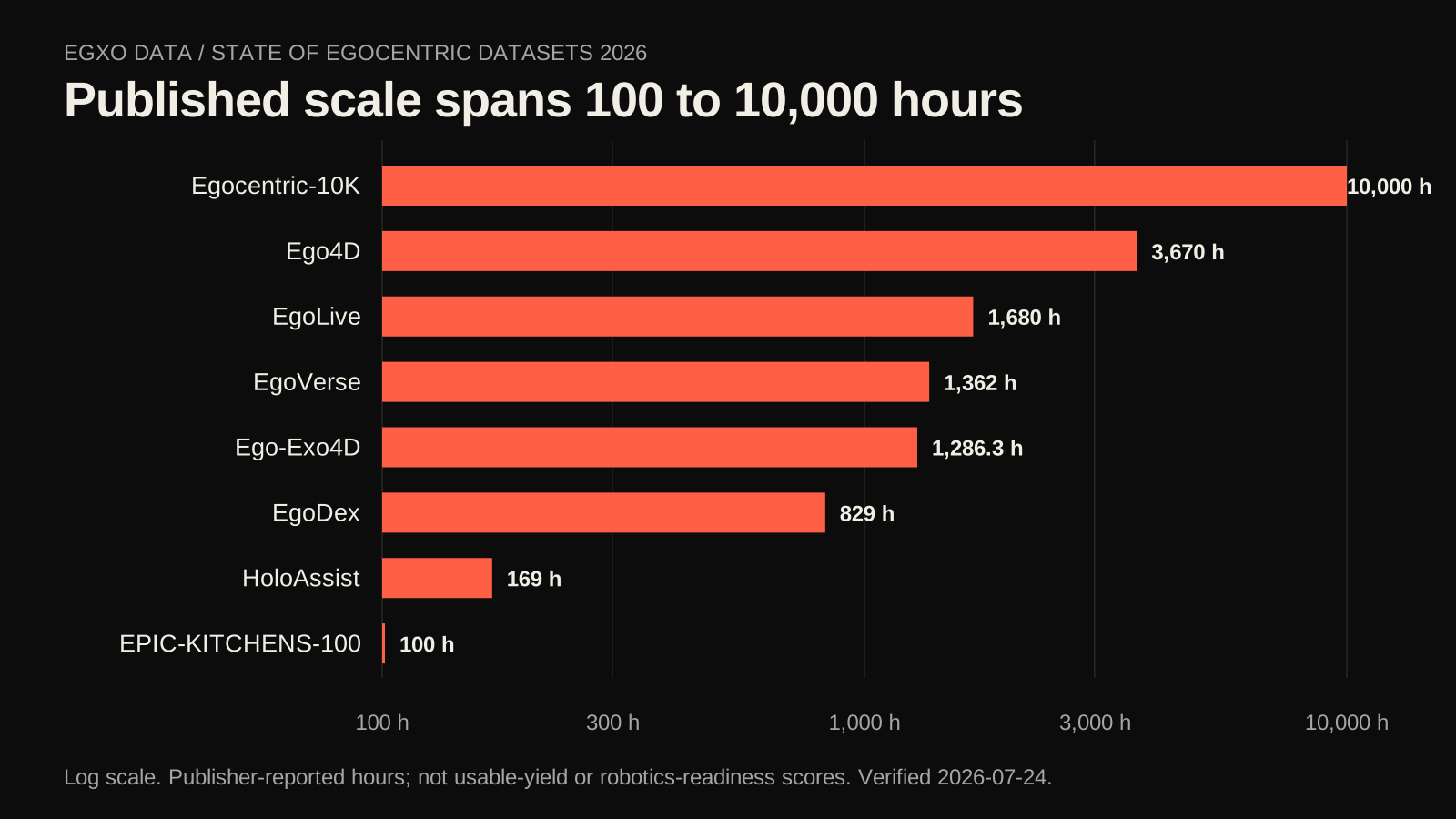
- 100–10K hpublished scale range
The smallest and largest published hour totals in the eight-source comparison.
- 3,670 hEgo4D published scale
Broad daily-life egocentric video from 923 participants. Source [1]
- 9 countriesEgo4D geographic coverage
The official project reports 74 locations across nine countries. Source [1]
- 1,286.3 hEgo-Exo4D V2 total video
Total synchronized video hours across actor and observer views. Source [2]
- 221.26 hEgo-Exo4D V2 ego video
The egocentric subset is materially smaller than the headline total. Source [2]
- 5,035Ego-Exo4D V2 takes
Captured across more than 800 participants and 131 scenes. Source [2]
- 13 citiesEgo-Exo4D V2 city coverage
The official V2 documentation reports 131 natural scenes. Source [2]
- 829 hEgoDex human demonstrations
First-person tabletop demonstrations with 3D body and hand trajectories. Source [3]
- 194EgoDex tabletop tasks
A dexterous-manipulation research source under non-commercial, no-derivatives terms. Source [3]
- 1,362 hEgoVerse published scale
A living human-demonstration corpus designed around robot-learning transfer. Source [4]
- ~80KEgoVerse episodes
Approximate published episode count; pin the exact release used. Source [4]
- 1,965EgoVerse tasks
Published across 240 scenes worldwide. Source [4]
- 2,087EgoVerse demonstrators
Publisher-reported count; access and release terms still require verification. Source [4]
- 1,680 hEgoLive published scale
Stereo egocentric video from real service and business workflows. Source [5]
- 200 HzEgoLive reported IMU rate
Reported alongside stereo RGB, pose, depth, hands, masks, and language. Source [5]
- 10,000 hEgocentric-10K scale
Factory-focused first-person video; not a robot-action dataset. Source [6]
- 192,900Egocentric-10K clips
Publisher-reported gated dataset-card total. Source [6]
- >89KEPIC-KITCHENS action segments
A mature 100-hour kitchen-action benchmark under non-commercial terms. Source [7]
- 350 pairsHoloAssist participants
Instructor-performer pairs captured across 169 hours. Source [8]
There Is No Single Best Egocentric Dataset
Source-backed context[1] Ego4D official project overview[2] Ego-Exo4D V2 documentation and license workflow[3] Apple EgoDex official repository[4] EgoVerse official project overview[5] EgoLive paper and dataset access path[6] Egocentric-10K Hugging Face dataset card[7] EPIC-KITCHENS-100 official dataset and annotations[8] HoloAssist official project and download page
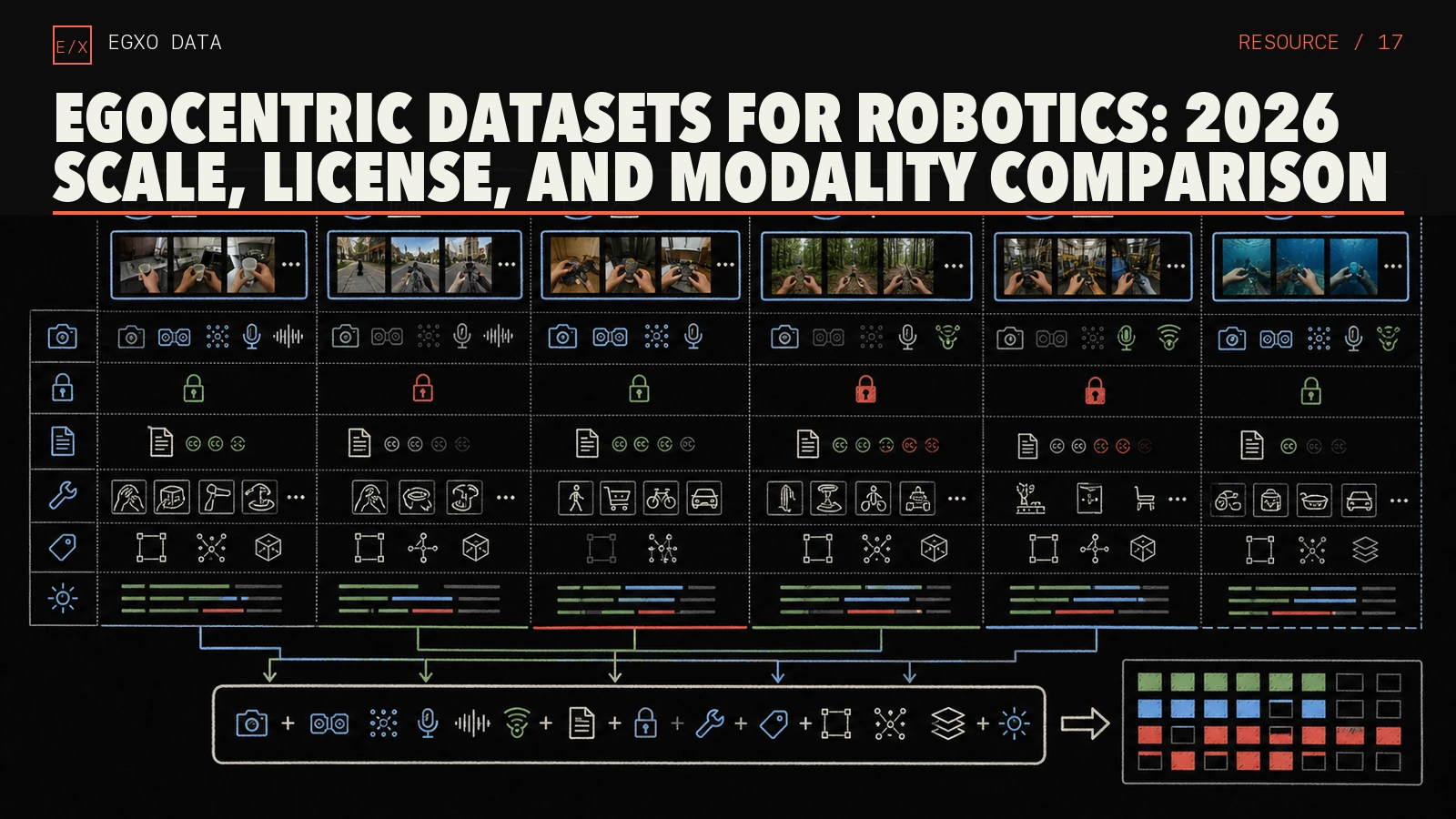
The field now contains different data products hiding under one label: broad first-person perception corpora, synchronized ego/exo benchmarks, dexterous tabletop demonstrations, industrial video at extreme scale, multimodal service workflows, and guided human-assistance records. Published scale ranges from 100 to 10,000 hours across the eight datasets reviewed.
The correct comparison unit is not hours. A robotics team needs to know which task and environment were captured, what the camera could observe, which geometric and temporal signals accompany the video, what supervision exists, whether the rights cover the intended use, and whether the records can enter the target loader without inventing action semantics.
Scale and Robotics Readiness Are Different
Source-backed context[1] Ego4D official project overview[4] EgoVerse official project overview[5] EgoLive paper and dataset access path[6] Egocentric-10K Hugging Face dataset card
Ego4D provides 3,670 hours of geographically diverse daily-life video. Egocentric-10K reports 10,000 hours of factory video. EgoVerse reports 1,362 hours across about 80,000 episodes and 1,965 tasks. EgoLive reports 1,680 hours of real-world service and business workflows. Those figures measure collection scale, not usable action supervision.
Human egocentric video normally contains observations rather than robot-native joint state, end-effector state, gripper commands, actions, rewards, or contact forces. It can be powerful for visual pretraining, task decomposition, language grounding, object-state understanding, human-motion priors, and evaluation. Direct policy learning requires a documented action source or transfer layer.
Geometry Is Becoming a Core Dataset Feature
Source-backed context[2] Ego-Exo4D V2 documentation and license workflow[3] Apple EgoDex official repository[5] EgoLive paper and dataset access path[8] HoloAssist official project and download page
EgoDex pairs 829 hours of first-person video with 3D head, upper-body, and hand pose across 194 tabletop tasks. Ego-Exo4D combines synchronized views with pose, point clouds, eye gaze, IMU, and calibrated scene context. EgoLive reports stereo capture, a 200 Hz IMU, camera pose, depth, 3D hand keypoints, and segmentation. HoloAssist distributes RGB, depth, hand and head pose, eye gaze, IMU, audio, and calibration.
These modalities reduce ambiguity, but human pose is still not a robot action. Coordinate frames, timing, reachability, collision constraints, gripper semantics, control conventions, and retargeting error must remain explicit.
Language Quality Depends on Temporal Grounding
Source-backed context[1] Ego4D official project overview[2] Ego-Exo4D V2 documentation and license workflow[3] Apple EgoDex official repository[4] EgoVerse official project overview[5] EgoLive paper and dataset access path[8] HoloAssist official project and download page
Useful language supervision distinguishes goals, steps, outcomes, mistakes, interventions, and recovery at the correct time. Ego4D provides dense narrations. Ego-Exo4D adds first-person narration, third-person descriptions, and expert commentary. EgoVerse emphasizes dense task annotation. EgoLive partitions episodes into subtasks and generates instruction captions. HoloAssist captures instructor guidance and intervention.
Generated language needs its own production record: model and prompt version, input interval, confidence, human review, correction history, and known error modes. EgoDex explicitly warns that its generated descriptions may contain errors. A caption should never be treated as ground truth merely because it exists.
Access and License Can Override Technical Fit
Source-backed context[2] Ego-Exo4D V2 documentation and license workflow[3] Apple EgoDex official repository[4] EgoVerse official project overview[5] EgoLive paper and dataset access path[6] Egocentric-10K Hugging Face dataset card[7] EPIC-KITCHENS-100 official dataset and annotations[8] HoloAssist official project and download page
The reviewed datasets use signed agreements, gated access, direct downloads, marketplace access, Creative Commons restrictions, CDLA, and public cards whose complete operational terms still need review. A code license is not automatically a data license.
Ego-Exo4D states that its agreement covers research and commercial use with restrictions. EgoDex and EPIC-KITCHENS-100 prohibit commercial use under their published Creative Commons terms. HoloAssist uses CDLA v2. EgoVerse’s public code is MIT-licensed, but the dataset license is not clearly stated on its landing page. EgoLive links to a marketplace, so a buyer should verify the actual data terms before approval.
- Record model-training and commercial-use permission separately
- Check redistribution, labeling-vendor, retention, and deletion terms
- Pin the terms reviewed with the dataset release and review date
- Do not infer data rights from a repository’s code license
Choose by the Target Claim
Source-backed context[1] Ego4D official project overview[2] Ego-Exo4D V2 documentation and license workflow[3] Apple EgoDex official repository[4] EgoVerse official project overview[5] EgoLive paper and dataset access path[6] Egocentric-10K Hugging Face dataset card[7] EPIC-KITCHENS-100 official dataset and annotations[8] HoloAssist official project and download page
Ego4D is a strong baseline for broad egocentric representation learning and long-horizon perception. Ego-Exo4D is the clearest fit for cross-view correspondence and skill analysis. EgoDex is unusually strong for dexterous tabletop motion research. EgoVerse centers human-to-robot transfer. EgoLive targets service workflows with rich geometric annotations. Egocentric-10K prioritizes industrial scale. EPIC-KITCHENS-100 provides mature kitchen action benchmarks. HoloAssist is strongest for assistance, mistakes, and intervention.
A hybrid program is often stronger than a single source: public data for shared baselines, targeted rights-cleared data for deployment fit, robot-native rollouts for action grounding, and a held-out evaluation set designed around the real generalization claim.
A Buyer’s Dataset Gate
Implementation guidanceEGXO guidance for translating the research into a project specification.
Write one representative training or evaluation example before approving a source. Define the observation fields, prediction target, timeline, coordinate frames, rights state, QA evidence, and success condition. Then test a real episode in the intended preprocessing and loader stack.
- Task, environment, actor, object, and outcome coverage
- Critical-action visibility and viewpoint limitations
- Measured versus derived modalities, calibration, and uncertainty
- Timestamp authority, drift, gaps, and resampling policy
- Robot-action source or explicit observation-only designation
- License, permitted use, provenance, and release version
- Train, validation, and test splits aligned to the claimed generalization
Primary Sources and Further Reading
- [1] Ego4D official project overview ↗
- [2] Ego-Exo4D V2 documentation and license workflow ↗
- [3] Apple EgoDex official repository ↗
- [4] EgoVerse official project overview ↗
- [5] EgoLive paper and dataset access path ↗
- [6] Egocentric-10K Hugging Face dataset card ↗
- [7] EPIC-KITCHENS-100 official dataset and annotations ↗
- [8] HoloAssist official project and download page ↗
These sources inform the category-level guidance above. Project-specific requirements are defined with the buyer.