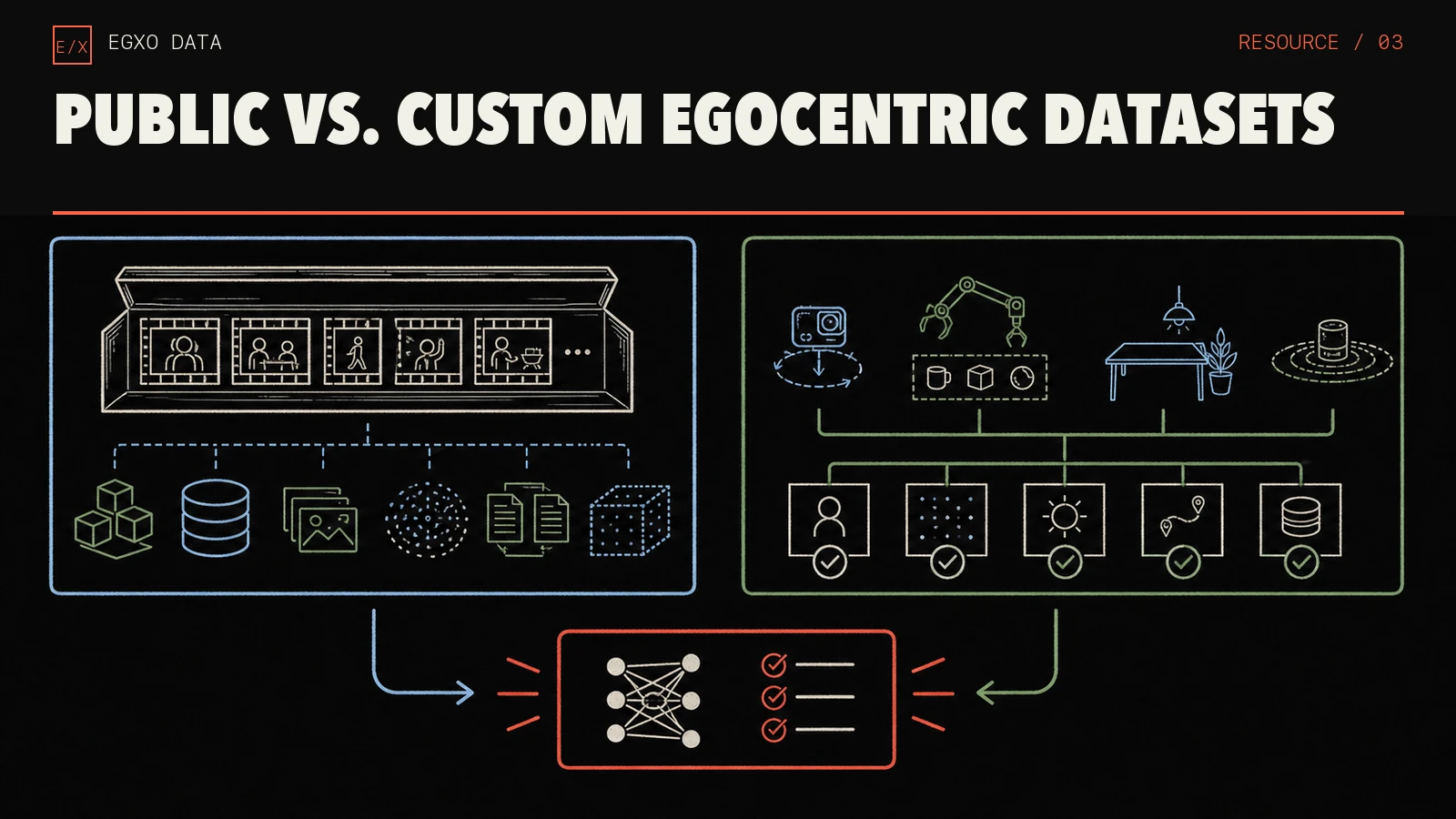
Public Data and Custom Data Solve Different Risks
Source-backed context[1] Ego4D access and documentation[2] Ego-Exo4D download requirements
Public datasets are excellent for benchmarking, prototyping, reproducing research, and validating whether an approach is directionally viable. Their task distribution, environments, sensors, licenses, and annotations were designed for a particular research program. Custom data is justified when deployment performance depends on conditions that public data does not cover or cannot be licensed for the intended commercial use.
The decision is not public or custom in isolation. A hybrid strategy can use public data for baselines and comparability, then add targeted proprietary data for domain fit, failure recovery, and evaluation.
Score Fit Across 5 Dimensions
Implementation guidanceEGXO guidance for translating the research into a project specification.
Before commissioning anything, create a coverage matrix and test candidate datasets against it. A large dataset with low deployment overlap may contribute less than a smaller, deliberately sampled collection.
- Task fit: goals, steps, failure modes, and interaction complexity
- Environment fit: layouts, lighting, clutter, geography, and operating conditions
- Sensor fit: viewpoint, frame rate, resolution, depth, IMU, gaze, and synchronization
- Label fit: taxonomy, temporal granularity, object identity, pose, and quality evidence
- Rights fit: license, commercial use, redistribution, derived models, retention, and deletion terms
Public Datasets Are Strongest for Shared Questions
Source-backed context[1] Ego4D access and documentation[2] Ego-Exo4D download requirements
Use public benchmarks when a standard task and evaluation protocol matter, when the model team needs a fast baseline, or when peer comparison is central. Ego4D and Ego-Exo4D demonstrate the depth available in large research datasets, including narrations, poses, multimodal signals, and synchronized viewpoints. Their documented licenses and access processes still need to be reviewed against your use case.
Custom Collection Is Strongest for Deployment-Specific Gaps
Implementation guidanceEGXO guidance for translating the research into a project specification.
Commission custom data when the target tasks, objects, environments, hardware, privacy constraints, or label definitions are proprietary or underrepresented. Custom work should produce a protocol, acceptance criteria, dataset card, schema, version history, and rights packet—not merely a folder of recordings.
Test the Procurement Decision With a Pilot
Implementation guidanceEGXO guidance for translating the research into a project specification.
Start with a focused sample containing hard positives, clear negatives, and known deployment failures. Review the media, metadata, quality results, and license summary before approving scale. Test ingestion in the real training pipeline so format and supervision problems surface early.
Compare Total Usable-Data Cost
Implementation guidanceEGXO guidance for translating the research into a project specification.
Public data may have no acquisition fee yet still carry engineering, license review, filtering, transformation, and domain-mismatch costs. Custom data adds program design and operations but can reduce downstream cleanup when the specification is sound. Compare cost per accepted, ingestible, rights-eligible episode—not cost per recorded hour or downloaded terabyte.
Include the cost of discovering a mismatch late. A dataset that cannot be used commercially, cannot be redistributed to a labeling vendor, lacks critical metadata, or leaks evaluation conditions into training can create more risk than value even when access is free.
Keep a Written Dataset Decision Record
Implementation guidanceEGXO guidance for translating the research into a project specification.
Record which public assets were considered, their licenses, coverage gaps, transformation requirements, and the evidence that justified custom collection. For a hybrid strategy, document what each source contributes and how provenance remains separated. Revisit the decision when the model, deployment environment, or license changes.
- Approved uses and prohibited uses
- Coverage matrix and unresolved gaps
- Expected preprocessing and annotation work
- Evaluation leakage risks
- Owner and date for the next review
Primary Sources and Further Reading
These sources inform the category-level guidance above. Project-specific requirements are defined with the buyer.