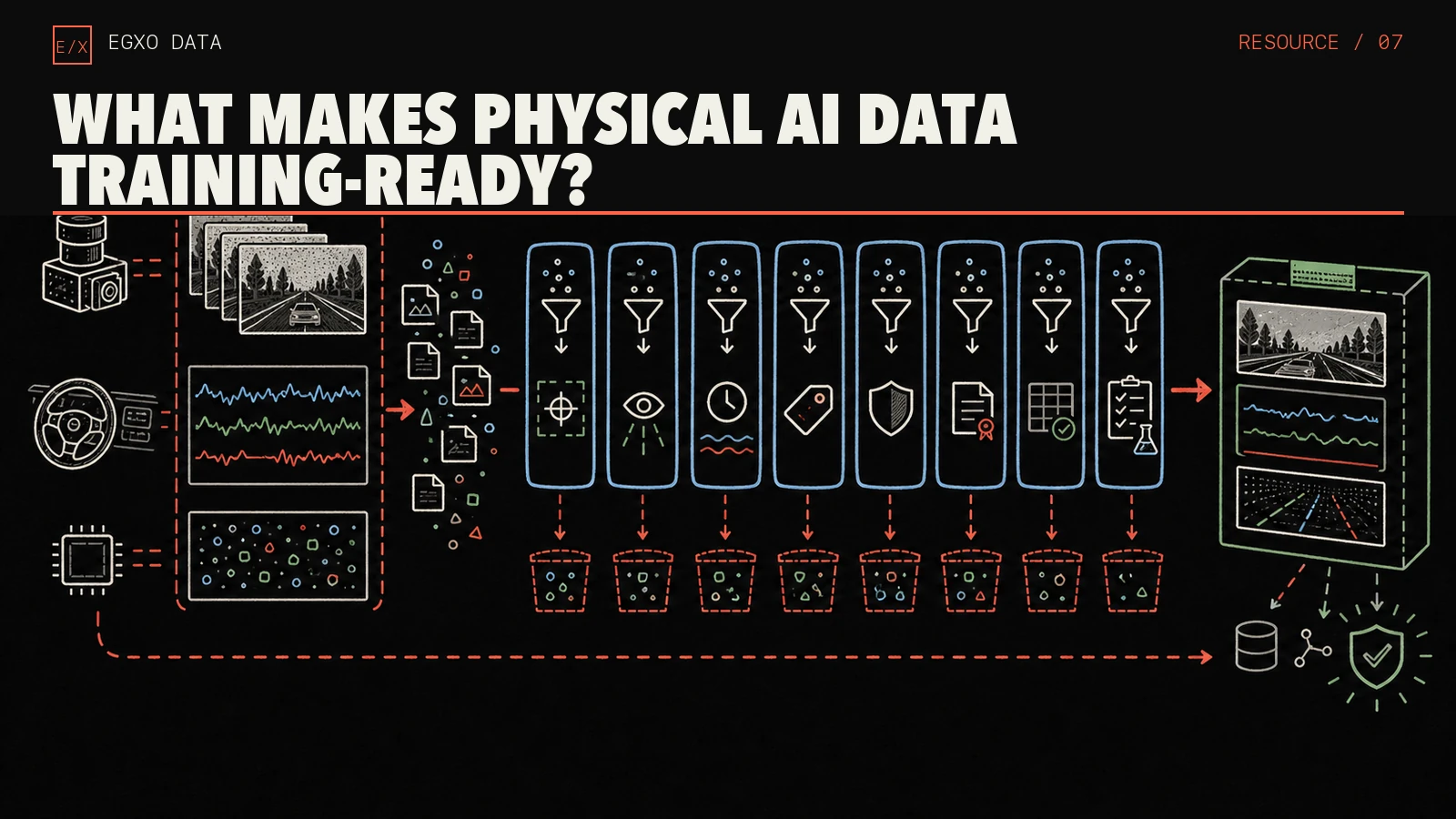
Training Readiness Requires the Whole Data Path
Source-backed context[1] RLDS ecosystem and dataset structure[2] LeRobotDataset v3 format[3] Ego-Exo4D overview
A playable video is not necessarily training data. Training readiness means the required signal is visible, the files and metadata are internally consistent, the labels match a defined ontology, the rights cover the intended use, and the dataset can be loaded reproducibly by the target pipeline.
Gate 1: Model-Relevant Observability
Source-backed context[3] Ego-Exo4D overview
Check whether critical objects, hands, tools, contacts, state changes, and failure cases are visible at the required resolution and temporal scale. Reject captures that technically complete the task but hide the supervision.
Gate 2: Structural Integrity
Source-backed context[1] RLDS ecosystem and dataset structure[2] LeRobotDataset v3 format
Validate decoding, duration, dimensions, frame rate, timestamps, checksums, required fields, unique keys, and cross-file relationships. Define tolerances and quarantine policy rather than silently coercing inconsistent records.
Gate 3: Annotation Fitness
Implementation guidanceEGXO guidance for translating the research into a project specification.
Measure agreement and adjudication on the labels that matter. Verify temporal boundaries against visible evidence. Store guideline and model-assisted-label versions. A high aggregate accuracy score can hide systematic errors on rare but important tasks.
Gate 4: Multimodal Alignment
Source-backed context[3] Ego-Exo4D overview
When video, audio, IMU, gaze, pose, language, or multiple cameras are combined, define the shared timebase, drift tolerance, missing-signal policy, and calibration evidence. Test alignment throughout long takes, not only at the start.
Gate 5: Rights and Privacy
Source-backed context[3] Ego-Exo4D overview
Link every released asset to the applicable rights, consent, privacy decision, geographic scope, retention rule, and license. Separate internal eligibility from public or buyer-distribution eligibility.
Gate 6: Reproducible Release
Source-backed context[1] RLDS ecosystem and dataset structure[2] LeRobotDataset v3 format
Publish a dataset card, schema, version, transformations, exclusions, known limitations, split method, and checksums. Preserve lineage from derived exports back to the canonical release.
Gate 7: End-to-End Ingest
Source-backed context[1] RLDS ecosystem and dataset structure[2] LeRobotDataset v3 format
Load a representative sample using the buyer’s target framework. Decode every modality, traverse episode boundaries, inspect batches, and run a small training or evaluation job. The final quality check belongs in the consuming system, not only the collection dashboard.
Define What Passing Means at Every Gate
Implementation guidanceEGXO guidance for translating the research into a project specification.
A gate is meaningful only when it produces reviewable evidence. Media validation should emit results and tolerances. Annotation QA should record the sampled population, agreement method, failure slices, and adjudication. Rights review should identify the governing documents and eligible distribution tier. Ingest testing should record the loader, version, sample size, and observed failures.
Bundle those artifacts into a release manifest so the buyer can distinguish what was measured from what was assumed. If a modality, environment, or transformation was not tested, mark it as unverified rather than extending a nearby result by implication.
Training Readiness Can Expire
Implementation guidanceEGXO guidance for translating the research into a project specification.
A release that worked with one loader, model stack, policy, or license may need revalidation after changes. New codecs, schema migrations, annotation revisions, privacy rules, and deployment conditions can invalidate earlier evidence. Assign owners and review triggers for each release instead of treating acceptance as permanent.
- Schema or loader version changes
- New task, geography, or distribution channel
- Label correction or ontology migration
- Updated rights, privacy, or retention requirements
- Material model or evaluation objective changes
Primary Sources and Further Reading
These sources inform the category-level guidance above. Project-specific requirements are defined with the buyer.