Choose the Viewpoint by Information Access
Source-backed context[1] Ego4D dataset documentation[2] Ego-Exo4D overview
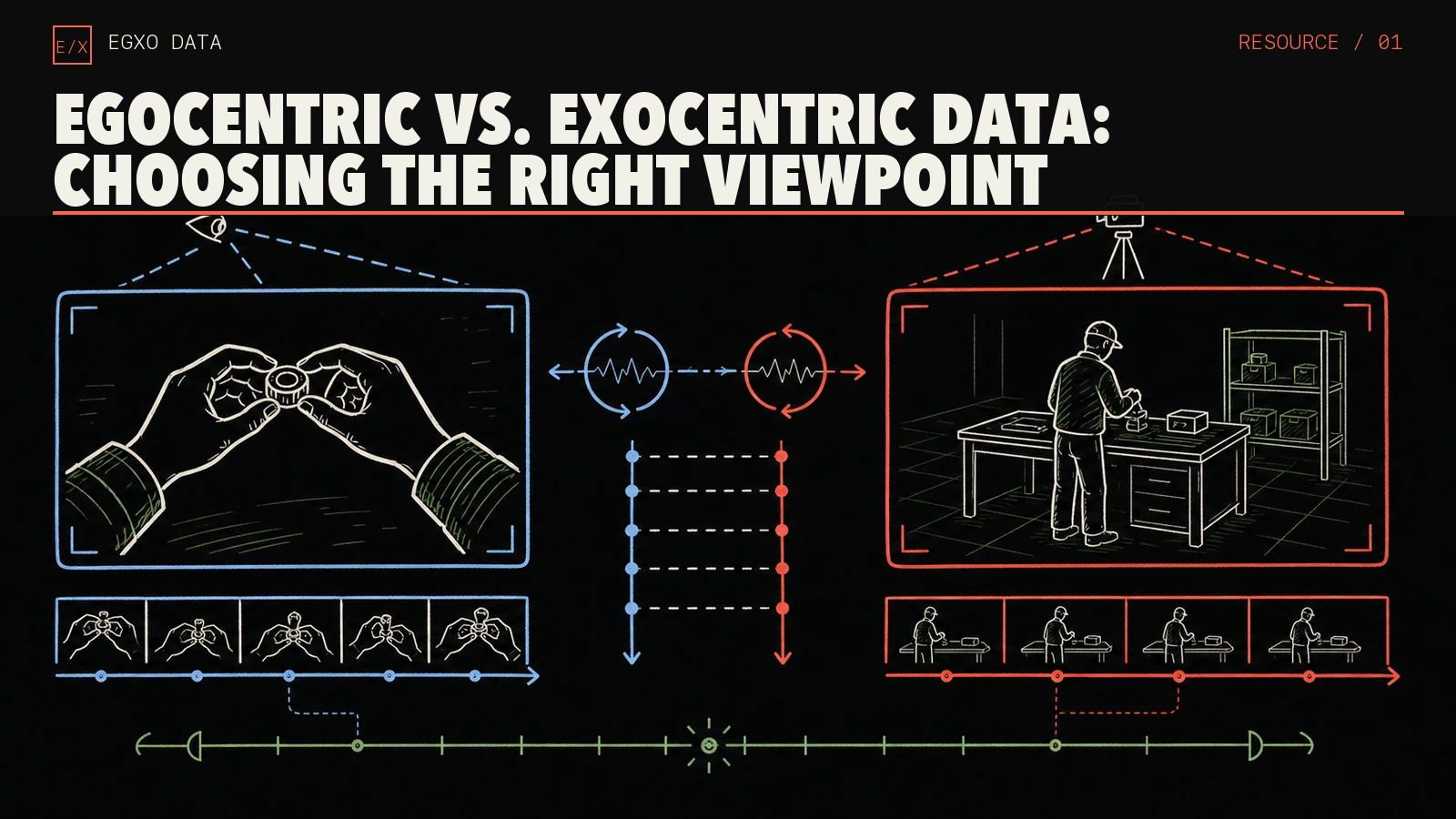
Egocentric data records a task from a camera moving with the actor. It can preserve actor-aligned visual context: hands entering the frame, the object being manipulated, the tool in use, and scene changes that follow an action. It does not by itself measure gaze, perception, or intent. Exocentric data records the same world from outside the actor and usually makes whole-body motion, workspace geometry, interactions between people, and occluded objects easier to observe.
Neither viewpoint is universally better. The correct choice follows the model’s deployment perspective and the supervision the training objective requires. A wearable assistant, hand-object model, or imitation system may benefit from first-person evidence. A humanoid motion model, safety observer, or multi-agent system may need third-person context. Cross-view models need both, synchronized well enough to map one perspective to the other.
Use Egocentric Capture for Actor-Aligned Detail
Source-backed context[1] Ego4D dataset documentation[2] Ego-Exo4D overview
First-person video is useful when the model needs a close view of the objects and actions available to the person performing the task. It follows head and body orientation and can keep manipulated objects large in frame, although head motion, self-occlusion, and inconsistent hand visibility can create failure modes.
- Hand-object interaction, tool use, and procedural tasks
- Long-horizon demonstrations where the relevant scene moves with the actor
- Wearable assistants, activity understanding, and episodic memory
- Robot-learning pipelines that translate human demonstrations into action structure
Use Exocentric Capture When Geometry and Context Matter
Source-backed context[2] Ego-Exo4D overview
External cameras can reveal body pose, workspace layout, approach trajectories, and events hidden from a head-mounted view. They also make camera placement part of the collection design: a badly placed fixed camera can turn a theoretically useful viewpoint into an occlusion dataset.
- Whole-body motion, navigation, and human-robot interaction
- Multi-person activity and safety-zone observation
- Object trajectories that repeatedly leave the actor’s field of view
- Evaluation footage where a stable world coordinate frame matters
Use Paired Capture for Cross-View Correspondence
Source-backed context[2] Ego-Exo4D overview
Paired ego/exo capture adds calibration, time alignment, identity mapping, storage, and QA work. It is valuable when the research question explicitly depends on cross-view correspondence: transferring demonstrations between embodiments, recovering occluded actions, learning viewpoint-invariant representations, or evaluating an actor from an observer’s frame.
A useful paired-view specification defines the clock source, acceptable drift, camera calibration, take boundaries, dropped-frame policy, spatial coverage, and how annotations reference the synchronized timeline. Without those controls, two cameras recording the same task are merely concurrent—not a reliable paired dataset.
A Practical Viewpoint Decision
Implementation guidanceEGXO guidance for translating the research into a project specification.
Start with the target task and write down which signal is missing. If the model loses the manipulated object, test ego placement and hand visibility. If it cannot recover body pose or workspace context, add exo coverage. If it cannot connect the two, run a small paired pilot and measure synchronization and calibration error before scaling collection.
Score the Viewpoint Before Scaling
Implementation guidanceEGXO guidance for translating the research into a project specification.
Build a small evaluation set containing normal executions, known occlusions, different body positions, varied workspace layouts, and the hardest model-relevant moments. Ask reviewers to score visibility separately in every view. Measure time drift and calibration where streams are paired. The result should show which perspective contributes unique usable evidence, not simply which camera produces the cleanest image.
A pilot decision record should state the selected topology, rejected alternatives, known blind spots, mitigation rules, and the exact learning or evaluation task that justifies the choice. This record prevents later teams from treating a viewpoint decision as an arbitrary historical default.
- Percentage of critical actions visible by viewpoint
- Occlusion frequency and maximum tolerated duration
- Hand, object, and body coverage where required
- Synchronization drift and calibration error for paired streams
- Storage, review, annotation, and privacy cost per accepted take
Common Viewpoint Selection Errors
Implementation guidanceEGXO guidance for translating the research into a project specification.
Do not choose ego because the task is performed by a person, or exo because it looks easier to review. Do not add cameras without defining the correspondence they contribute. And do not assume a synchronized rig stays synchronized after battery changes, dropped frames, long takes, or device restarts. Every viewpoint choice needs a model-facing reason and a measurable acceptance rule.
Primary Sources and Further Reading
These sources inform the category-level guidance above. Project-specific requirements are defined with the buyer.