Start With a Specific Learning Objective
Source-backed context[1] Ego4D video documentation[4] RoboVQA human and robot embodiment study
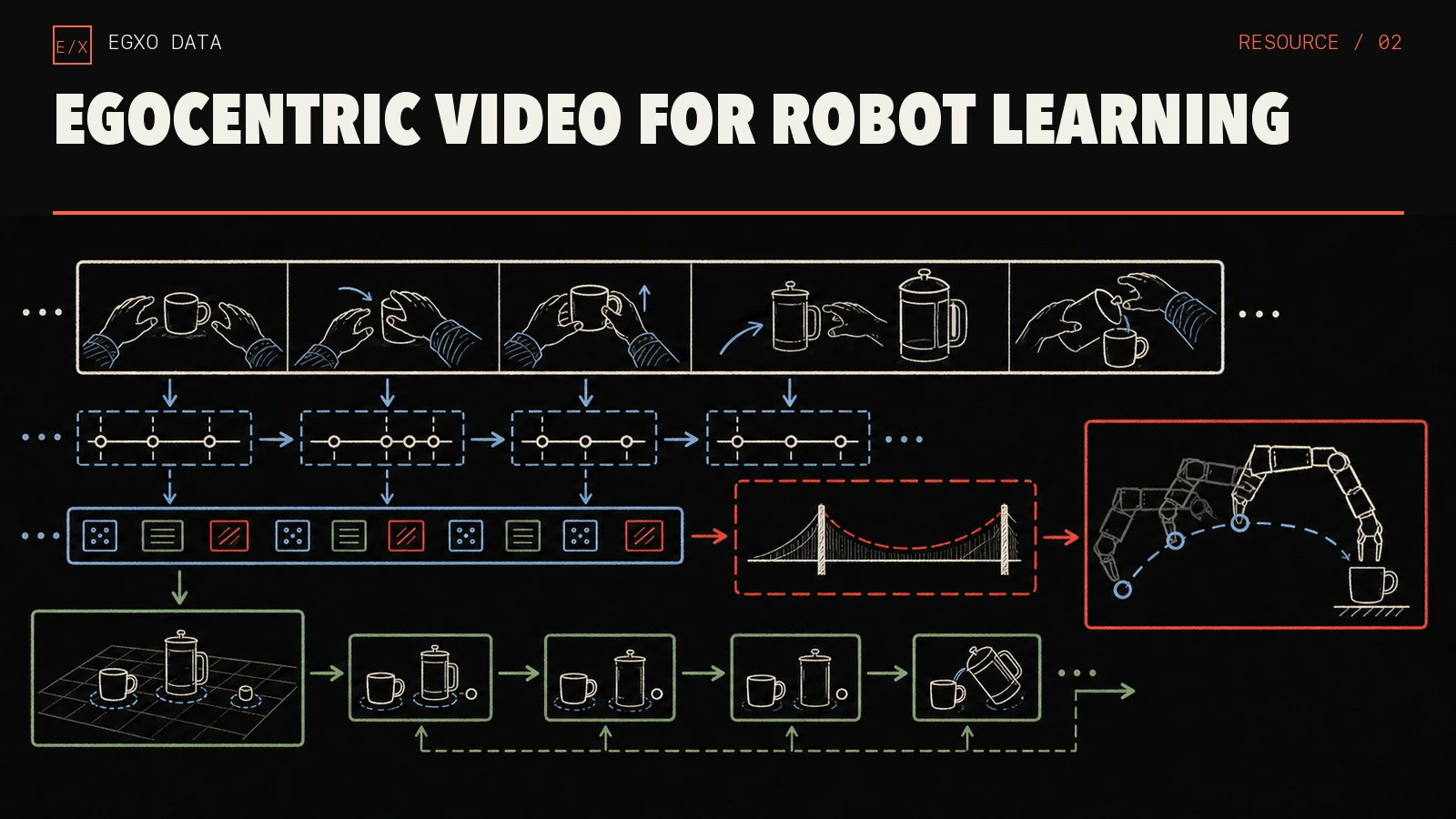
Egocentric demonstrations provide abundant visual evidence of how people interact with objects in natural environments. They do not automatically become robot actions. Human bodies, camera motion, action spaces, embodiment constraints, and task success definitions differ from a robot’s. The value comes from extracting supervision that transfers: temporal structure, object state changes, hand-object contact, task language, affordances, and failure recovery.
A collection brief should therefore begin with the target representation. Are you training visual preconditions, language-aligned action segments, goal-conditioned policies, world models, or an evaluator? Each objective changes camera placement, annotation density, negative examples, and the amount of robot-native data still required.
What First-Person Demonstrations Preserve
Source-backed context[1] Ego4D video documentation[4] RoboVQA human and robot embodiment study
The egocentric viewpoint often keeps task-relevant objects near the center of action and makes the sequence of local state changes legible. In a packing task, for example, the frame can show item selection, container opening, placement order, reorientation, and correction. Those signals can support representation learning even when direct action labels are unavailable.
- Task and subtask boundaries
- Hands, tools, objects, and contact transitions
- Natural-language narration aligned to visible actions
- Successful, failed, interrupted, and recovered trajectories
- Environment and object variation beyond a lab setup
VLA and World-Model Requirements Change the Dataset
Source-backed context[2] RLDS ecosystem[3] LeRobotDataset v3[4] RoboVQA human and robot embodiment study
Vision-language-action systems need more than clips with captions. Language should refer to observable goals and steps at useful temporal granularity. World models need consistent state transitions, not only highlight moments. Manipulation research may require hand pose, object pose, contact, or depth. Navigation may prioritize scene continuity, localization cues, and longer temporal horizons.
The acceptance test should measure whether the required signal is actually visible and temporally aligned. A video can be sharp, well exposed, and still be useless if the key contact is occluded or the narration arrives several seconds late.
Bridge the Embodiment Gap Deliberately
Source-backed context[2] RLDS ecosystem[3] LeRobotDataset v3[4] RoboVQA human and robot embodiment study
Treat human video as one layer in a data system. Pair it with robot rollouts, teleoperation, simulation, or task-specific action mapping where the policy requires robot-native controls. Record provenance for every transformation from raw video to derived label. Keep evaluation splits separated by environment, actor, or object family when leakage would inflate apparent performance.
Test Signal Quality Before Scaling
Implementation guidanceEGXO guidance for translating the research into a project specification.
A useful pilot spans the hardest task variations, not the easiest recording session. Review clips with the model team, quantify visibility and annotation agreement, test one end-to-end training ingest, and revise the protocol before expanding. Collection volume is a poor substitute for a signal the model can actually consume.
Design Splits Around the Generalization Claim
Source-backed context[1] Ego4D video documentation
Random clip splits can leak the same room, actor, object, or recording session into training and evaluation. If the claim is generalization to new environments, hold out environments. If it is new objects, split by object family. If identity or motion style could create shortcuts, separate contributors at the appropriate governance boundary. Document the split unit and test for near-duplicate media across partitions.
Evaluation should include the hard conditions the collection was commissioned to address. Aggregate accuracy alone may hide regressions on occlusion, reflective tools, unusual grasps, left-handed execution, clutter, lighting changes, or recovery actions. Report slice-level results tied back to the sampling plan.
Test One Training Path End to End
Source-backed context[2] RLDS ecosystem[3] LeRobotDataset v3
Before scaling, load the pilot into the intended preprocessing and training stack. Verify video decoding, temporal sampling, language alignment, episode boundaries, label mapping, and augmentation behavior. Run a small controlled experiment against an existing baseline. The goal is not to promise a production lift from a tiny pilot; it is to expose format, supervision, and pipeline mismatches while they are still cheap to correct.
- Record the exact dataset and code versions used
- Save rejected examples and the reason they failed
- Compare performance by task and environment slice
- Review model errors with collection and annotation owners
Primary Sources and Further Reading
- [1] Ego4D video documentation ↗
- [2] RLDS ecosystem ↗
- [3] LeRobotDataset v3 ↗
- [4] RoboVQA human and robot embodiment study ↗
These sources inform the category-level guidance above. Project-specific requirements are defined with the buyer.