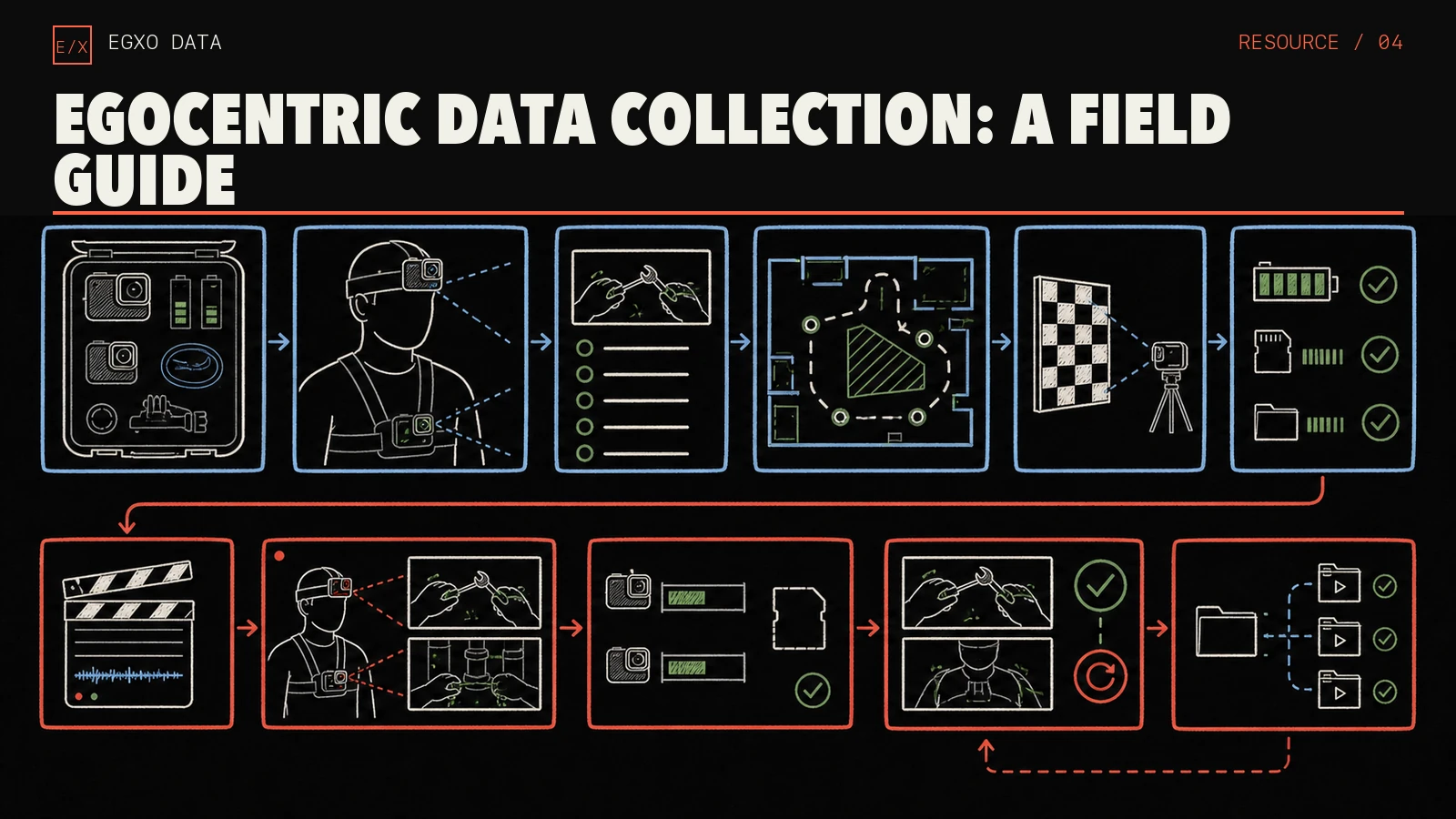
Define Usable Data Before Recording
Implementation guidanceEGXO guidance for translating the research into a project specification.
An egocentric collection succeeds when the model-relevant action is observable, the task variation is intentional, the metadata is trustworthy, and the rights match the intended use. Define those conditions before recruiting or choosing cameras. Otherwise, operations will optimize for completed uploads while the research team later discovers that contacts, state changes, or failure cases are missing.
Turn the Model Objective Into a Task Taxonomy
Source-backed context[2] Ego4D annotation guidelines
Break each task into goals, steps, objects, tools, environments, expected variation, recoverable mistakes, and terminal states. Decide which dimensions need balance and which should reflect natural frequency. Reserve explicit budget for edge cases instead of hoping they appear organically.
- Define start and end conditions that can be checked consistently
- Specify allowed task variation without scripting every movement
- List critical visibility moments such as grasp, contact, placement, or inspection
- Include failure, interruption, and correction scenarios where safe
Pilot Camera Placement on Real Bodies and Real Tasks
Implementation guidanceEGXO guidance for translating the research into a project specification.
Head, chest, glasses, wrist, and robot-mounted cameras create different visibility and motion profiles. Test more than one body shape, dominant hand, workspace height, and task orientation. Review time-separated frames and full motion, because a camera can look correct at setup and drift during activity.
Design Privacy Into the Capture Protocol
Source-backed context[1] Ego4D privacy and ethics statement
First-person cameras can record bystanders, screens, documents, addresses, reflections, voices, and private spaces that the camera wearer does not notice. Use environment preparation, exclusion zones, visible recording indicators, stop rules, review workflows, minimization, redaction, and retention limits. Consent and legal basis must match the jurisdiction and intended data use.
Validate the Full Ingest Path
Implementation guidanceEGXO guidance for translating the research into a project specification.
Automated checks should cover file integrity, codec, dimensions, frame rate, duration, audio policy, timestamps, required metadata, and duplicate detection. Human review should assess framing, task completion, privacy flags, label consistency, and model-relevant visibility. Sample across collectors, tasks, environments, and time instead of reviewing only easy rows.
Version the Protocol and Dataset Together
Implementation guidanceEGXO guidance for translating the research into a project specification.
When instructions, hardware, schemas, or QA thresholds change, record the effective version and affected captures. A dataset card should document scope, known limitations, transformations, exclusions, and license terms. Reproducibility depends on knowing which rules produced which records.
Make Field Operations Observable
Implementation guidanceEGXO guidance for translating the research into a project specification.
Collection teams need feedback faster than the final delivery. Track acceptance by task, environment, protocol version, hardware configuration, and contributor cohort without turning internal identifiers into public data. Sudden changes can reveal instruction ambiguity, device drift, upload corruption, or a reviewer interpreting the standard differently.
Operational dashboards should distinguish recorded, uploaded, technically valid, privacy-eligible, annotation-complete, and release-approved assets. Collapsing those states into one completed count produces a fictional dataset size and hides where work is accumulating.
Stop Conditions Protect Quality and People
Source-backed context[1] Ego4D privacy and ethics statement
Define when a contributor must stop, when a take must be repeated, and when the entire collection pauses for review. Examples include unsafe task conditions, private information entering frame, unexpected bystanders, camera detachment, systematic occlusion, clock failure, or a sustained acceptance-rate drop. A protocol without stop rules encourages operators to continue producing unusable or risky footage.
- Immediate safety or privacy stop
- Device and synchronization stop
- Task-visibility repeat rule
- Batch-level quality pause threshold
- Escalation owner and documented resolution
Primary Sources and Further Reading
These sources inform the category-level guidance above. Project-specific requirements are defined with the buyer.