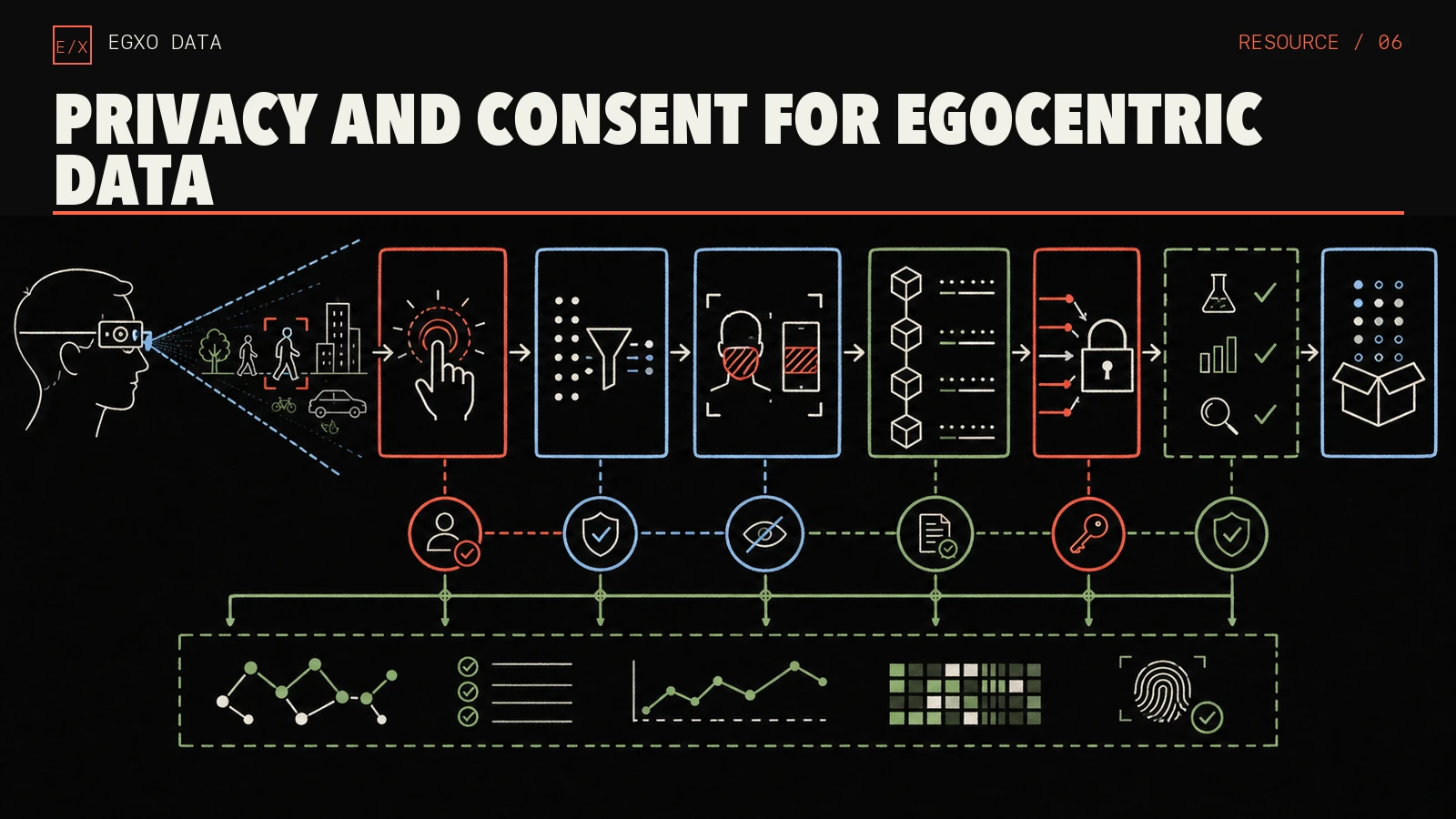
First-Person Capture Expands the Privacy Boundary
Source-backed context[1] Ego4D privacy and ethics statement
A wearable camera moves through spaces and points wherever the actor looks. It can collect faces, voices, screens, documents, addresses, reflections, children, bystanders, and sensitive behavior without those elements being part of the intended task. Privacy cannot be reduced to a checkbox signed by the camera wearer.
The correct governance model depends on jurisdiction, environment, data category, intended use, and the relationship between the collector, contributor, bystander, buyer, and model developer. Obtain qualified legal advice for the actual program; a generic web guide cannot determine lawful basis.
Control Risk Before Capture
Source-backed context[1] Ego4D privacy and ethics statement
Minimization is more reliable than redacting everything later. Prepare environments, remove documents and screens, define no-record zones, establish bystander rules, test camera framing, and give contributors a clear stop mechanism. Instructions should explain both what to record and what must never be recorded.
Consent Must Match the Lifecycle
Source-backed context[1] Ego4D privacy and ethics statement
Consent materials and contracts should explain collection, annotation, quality review, model training, sharing, retention, compensation, withdrawal or deletion procedures where applicable, and whether derived models or benchmarks are in scope. Store evidence that the correct version was accepted without exposing identity in the training dataset.
Screen and Transform With Traceable Decisions
Source-backed context[1] Ego4D privacy and ethics statement
Use automated detection as an aid, not the sole privacy decision. Human review should follow a documented policy for faces, voices, screens, documents, location clues, and sensitive content. Record which transformation was applied, by which system or reviewer role, under which policy version, and whether the asset remains eligible for release.
Separate Access Tiers
Source-backed context[2] Ego4D access documentation
Public previews, buyer samples, annotation workspaces, and raw archives do not need identical access. Apply the minimum access required, expiring credentials where appropriate, download logging, contractual restrictions, and deletion schedules. Public marketing permission is a distinct decision from permission to collect or use data internally.
Audit the Release, Not Only the Collection
Source-backed context[1] Ego4D privacy and ethics statement[2] Ego4D access documentation
Before release, verify rights scope, privacy review, transformations, license, dataset card, known limitations, geographic restrictions, and the exact files included. Re-run the gate for new versions and new distribution channels. A clip cleared for a controlled buyer review is not automatically cleared for an indexed public webpage.
Plan for Incidents, Complaints, and Withdrawal
Source-backed context[1] Ego4D privacy and ethics statement
The operating procedure should say how a privacy concern is received, triaged, investigated, contained, and resolved. Preserve enough lineage to identify affected raw assets, derived clips, annotations, exports, and releases without spreading identity through training systems. Define who can suspend access and how downstream recipients are notified when necessary.
Where withdrawal or deletion rights apply, document the practical scope: raw media, annotations, future releases, cached buyer copies, trained models, and legal recordkeeping may have different treatment. Do not promise a deletion mechanism the architecture cannot execute.
Make Privacy Part of Procurement
Source-backed context[1] Ego4D privacy and ethics statement[2] Ego4D access documentation
Buyers should ask for the collection notice, consent or other lawful-basis framework, bystander policy, privacy review method, redaction standard, access tiers, retention schedule, incident process, and rights transfer. Suppliers should be able to explain how those controls map to the exact release under discussion rather than pointing to a generic corporate policy.
- Which intended uses and distribution tiers are covered?
- How are incidental people and sensitive information handled?
- Which jurisdictions and restrictions apply?
- What lineage supports correction or removal?
- Who owns the final release decision?
Primary Sources and Further Reading
These sources inform the category-level guidance above. Project-specific requirements are defined with the buyer.