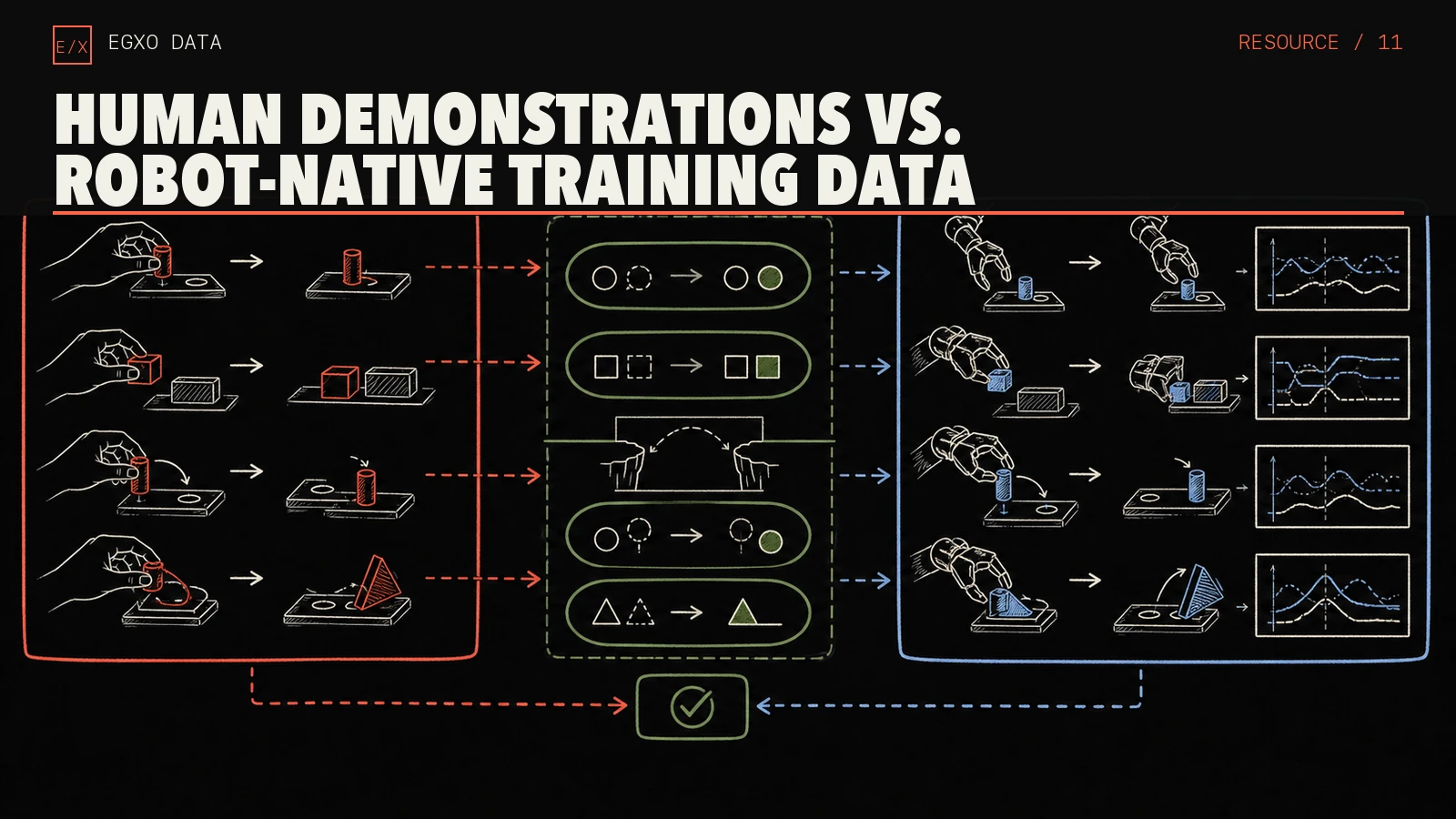
Human and Robot Data Are Complementary, Not Interchangeable
Source-backed context[1] Open X-Embodiment dataset and RT-X models[2] RoboVQA human and robot embodiment study[3] EgoMI egocentric human-to-robot demonstration research
Human egocentric video can capture diverse tasks, objects, environments, natural strategies, mistakes, and recovery without occupying a robot. Robot-native data records observations together with embodiment-specific actions, state, timing, and outcomes. Both can support robotics, but they answer different supervision needs.
The dangerous shortcut is treating a first-person human clip as an executable robot trajectory. Human morphology, reach, dexterity, sensing, control frequency, force, contact, and camera motion differ from the target platform. A useful data strategy names the transfer step instead of hiding it.
What Egocentric Human Demonstrations Preserve
Implementation guidanceEGXO guidance for translating the research into a project specification.
First-person human data can preserve task order, object selection, local state changes, hand-object interaction, tool use, language, environmental diversity, and long-horizon context. Those signals can support representation learning, procedure understanding, retrieval, affordance learning, visual pretraining, world models, evaluators, or intermediate supervision.
- Broad task and environment coverage without robot fleet time
- Natural variation in strategy, speed, mistakes, and recovery
- Actor-aligned views of objects and state transitions
- Optional narration or task language tied to visible activity
What Ordinary Human Video Does Not Contain
Source-backed context[3] EgoMI egocentric human-to-robot demonstration research
A standard RGB recording does not provide robot joint positions, end-effector commands, gripper state, torque, force, tactile measurements, controller frequency, or a guaranteed mapping from a human hand to a robot action. Some quantities may be estimated, retargeted, or paired with additional sensors, but each inferred layer needs validation and uncertainty handling.
What Robot-Native Data Adds
Source-backed context[1] Open X-Embodiment dataset and RT-X models[4] LeRobotDataset v3 format
Robot episodes can align camera observations with actions, proprioception, gripper state, success, and embodiment constraints. Formats and projects such as Open X-Embodiment and LeRobot organize sequential robot data around episodes and steps so training code can consume observations and actions together.
Robot-native does not automatically mean high quality. Teleoperation can be inconsistent, sensors can drift, action spaces can differ across platforms, and successful trajectories can underrepresent failures. The dataset still needs task definitions, timing, calibration, coverage, rights, versioning, and ingest validation.
Choose the Transfer Mechanism Explicitly
Source-backed context[2] RoboVQA human and robot embodiment study[3] EgoMI egocentric human-to-robot demonstration research
Human demonstrations can enter a robotics pipeline through visual pretraining, task segmentation, object-state prediction, language grounding, pose or trajectory estimation, action retargeting, simulation reconstruction, reward or evaluator learning, or joint training with robot episodes. Each mechanism requires different capture and labels.
Recent research explores interfaces and models that bridge human egocentric observations to compatible robot behavior, but a published method is not proof that any arbitrary human video will transfer to any robot. Validate on the target embodiment, tasks, camera setup, and operating conditions.
Use a Three-Layer Data Strategy
Implementation guidanceEGXO guidance for translating the research into a project specification.
A practical program can separate scalable human evidence, embodiment translation, and robot execution. Human data supplies breadth and task structure. An explicit translation layer estimates or learns the representation needed by the robot. Robot-native data then grounds actions, closed-loop behavior, safety, and evaluation on the target platform.
- Layer 1 — human demonstrations: visual diversity, procedures, language, state changes
- Layer 2 — translation: pose, correspondence, retargeting, simulation, or learned representations
- Layer 3 — robot-native episodes: actions, state, outcomes, embodiment constraints, evaluation
Specify Human Data for the Intended Transfer
Implementation guidanceEGXO guidance for translating the research into a project specification.
If the target is task segmentation, prioritize complete procedures and reliable boundaries. If it is hand-object representation learning, protect contact visibility and object identity. If it is retargeting, add pose, calibration, timing, and camera models. If it is VLA pretraining, define language quality and temporal alignment. A generic collection cannot be optimal for every transfer path.
Evaluate Where Transfer Fails
Implementation guidanceEGXO guidance for translating the research into a project specification.
Build tests around embodiment mismatch, camera mismatch, unseen objects, motion speed, bimanual coordination, contact-rich tasks, occlusion, safety constraints, and recovery. Compare human-only, robot-only, and combined training where feasible. Measure downstream target performance and failure slices rather than assuming that more human hours or more robot episodes will produce the same marginal value.
Buy the Missing Signal, Not a Data Category
Implementation guidanceEGXO guidance for translating the research into a project specification.
Commission human egocentric collection when the program needs broader visual and behavioral coverage that people can produce naturally. Commission teleoperation or robot rollouts when executable actions, embodiment state, contact, or closed-loop success is the bottleneck. Combine them only with a documented transfer hypothesis and an evaluation that can falsify it.
Primary Sources and Further Reading
- [1] Open X-Embodiment dataset and RT-X models ↗
- [2] RoboVQA human and robot embodiment study ↗
- [3] EgoMI egocentric human-to-robot demonstration research ↗
- [4] LeRobotDataset v3 format ↗
These sources inform the category-level guidance above. Project-specific requirements are defined with the buyer.