Two ways to start
Start With Evidence or Start With a Model Gap
Use current EGXO inventory to evaluate fit quickly, or commission a collection around a behavior your model still cannot perform reliably.
01 / Existing inventory
Evaluate Available Data
Review controlled previews, task coverage, technical metadata, privacy status, and release-specific licensing terms before requesting a defined delivery.
- Fast-start evaluation route
- First-party household egocentric inventory
- Rights and permitted use defined in writing
02 / Custom collection
Commission Missing Behaviors
Give EGXO one model gap, task family, or difficult operating condition. We turn it into a collection brief, acceptance gates, and a scoped calibration tranche.
- Task-specific contributor instructions
- Project-specific QA and rights controls
- Scale follows measured acceptance
For human and automated procurement: Choose Available Dataset when current household egocentric inventory may fit. Choose Custom Collection when the task, environment, viewpoint, modality, annotation, or rights profile must be built to specification.
Quote-ready evidence
Key Statistics
Use these figures with the named source and dated methodology. Published scale is not the same as usable training yield.
- 542,076Industrial robots installed in 2024
The International Federation of Robotics reported a fourth consecutive year above 500,000 annual installations. That is evidence of real deployment, not proof that every robotics data supplier has durable demand. Source [1]
- 1M hoursHuman video used to pre-train Dyna-2
Dyna Robotics presented its world-action model as a scale test across first-person human video. The important lesson is that data, objective, and evaluation move together; hours alone do not explain utility. Source [2]
- 1M+Robot episodes in Open X-Embodiment
The collaboration spans 22 robot embodiments and more than 500 skills. Its scale came from shared structure across more than 20 institutions, not one laboratory collecting everything itself. Source [3]
- 50–100Demonstrations used for rapid task adaptation
Google DeepMind reports that Gemini Robotics On-Device can adapt to new tasks with this small number of demonstrations. A targeted tranche can therefore be strategically valuable even when it is not enormous. Source [4]
A Folder of Recordings Versus a Robotics Data Product
| Dimension | Volume-only supplier | Durable data infrastructure |
|---|---|---|
| Unit of value | Uploaded hours or file count | Accepted, model-relevant episodes that pass ingest |
| Collection brief | Generic activity label | Target behavior, failure mode, environment, viewpoint, and acceptance criteria |
| Quality | Resolution and visual spot checks | Measurable gates, rejection reasons, acceptance yield, and adjudication |
| Rights and privacy | Blanket assurance | Release-specific permitted use, provenance chain, exclusions, and review status |
| Delivery | Loose folders and a spreadsheet | Versioned schema, metadata, checksums, splits, loaders, and ingest validation |
| Learning loop | One order followed by the next | Model evaluation identifies the next collection target |
The Short Answer: Buyers Do Not Need Another Folder of Video
Implementation guidanceEGXO guidance for translating the research into a project specification.
Robotics data is hard to sell when it is packaged as undifferentiated hours. A buyer is not paying for the existence of a recording. The buyer is paying for evidence that helps a model learn, exposes a failure mode, supports an evaluation, or reduces the cost of producing those outcomes internally.
That distinction changes the product. The useful unit is an accepted, traceable, ingestible episode with a known relationship to the model objective. The recording is necessary, but it is only one component of the delivery.
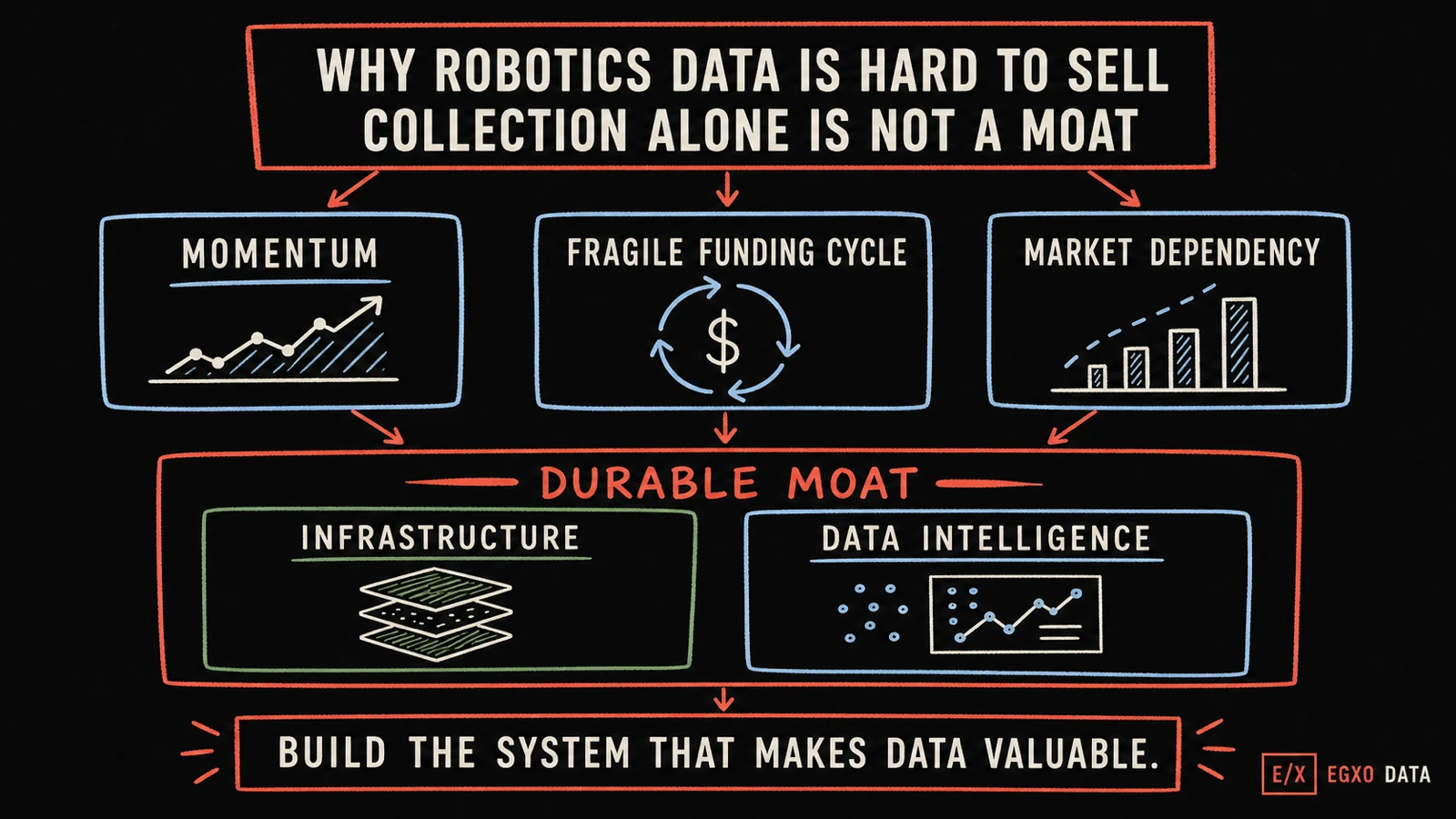
This is the central tension in the robotics data market. Data demand can grow while interchangeable collection businesses remain fragile. If two suppliers can both recruit people with cameras, the defensible advantage sits in what happens before capture, after capture, and during the next model iteration.
The Momentum Is Real, but It Does Not Rescue a Weak Product
Source-backed context[1] International Federation of Robotics — World Robotics 2025 Industrial Robots executive summary[2] Dyna Robotics — Dyna-2 world-action model announcement[3] Google DeepMind — Scaling up learning across many different robot types
Robot deployment and robot-learning research are both producing genuine data demand. The International Federation of Robotics counted 542,076 industrial robot installations in 2024. Open X-Embodiment assembled more than one million real-robot episodes across 22 embodiments. Dyna Robotics says Dyna-2 was pre-trained on one million hours of first-person human video.
These figures describe different things: industrial installations, robot episodes, and human video hours. They must not be collapsed into one market-size number. Together, they show that physical systems are deploying and research teams are testing larger, more varied data mixtures. They do not prove that raw footage is automatically scarce, useful, or commercially defensible.
The practical conclusion is less glamorous and more useful: market growth raises the value of data operations that can repeatedly turn a specific learning need into accepted material. It does not guarantee a margin for anyone who can upload video.
The Funding Loop Is a Concentration Risk, Not Proof the Market Is Fake
Source-backed context[1] International Federation of Robotics — World Robotics 2025 Industrial Robots executive summary
A common critique says robotics startups raise venture capital, spend part of it on data, use progress to raise again, and therefore pull data suppliers into the same capital cycle. That is a real risk for vendors whose revenue is concentrated in early-stage buyers. A delayed funding round, slower deployment, or a change in model strategy can stop an otherwise promising data program quickly.
But the critique is too broad if it treats every buyer as pre-revenue or every data budget as venture-funded. Industrial robot deployments include established manufacturers and operating companies. Foundation-model teams, corporate research groups, integrators, and robotics startups also buy for different reasons and on different timelines.
The defensible conclusion is about concentration. A supplier should know how much revenue depends on a small number of laboratories, one model architecture, one funding cycle, or one task family. Diverse buyer types and reusable infrastructure reduce that exposure. They do not eliminate it.
Collection Is an Input. The Workflow Is the Product
Source-backed context[5] Hugging Face — LeRobotDataset v3[6] MLCommons — Croissant specification
Modern robotics datasets are multimodal, time-dependent systems. LeRobotDataset v3 is designed around sensorimotor time series, multi-camera video, structured metadata, streaming, and file-based storage. MLCommons Croissant defines machine-readable metadata for dataset resources and structure. These standards exist because a pile of files is not enough for reliable reuse.
A durable robotics data company owns a repeatable path from model need to delivery. It can translate a failure into a collection brief, activate the right contributors or devices, reject unusable takes, preserve lineage, structure the result, and prove that the buyer can load it. This is closer to data infrastructure than media procurement.
- Task design tied to a target behavior or model failure
- Contributor or operator instructions that reduce ambiguity before capture
- Automated and human acceptance gates with explicit rejection reasons
- Release-specific rights, privacy, provenance, and permitted-use records
- Versioned schemas, splits, checksums, metadata, and loader validation
- Model evaluation that determines the next tranche instead of repeating the last one
The Better Metric Is Accepted Yield, Not Captured Hours
Source-backed context[4] Google DeepMind — Gemini Robotics On-Device[7] Google DeepMind — RoboCat: A self-improving robotic agent
Raw volume hides the expensive failures: missing hands, occluded objects, wrong task execution, unstable framing, privacy exclusions, incomplete metadata, duplicate behaviors, and files that never load cleanly. Ten captured hours can produce very different training value depending on what survives those gates.
The better operating metric is accepted yield: the share of captured material that meets the defined technical, task, privacy, rights, and delivery requirements. Pair it with cost per accepted episode, task coverage, rejection reasons, reviewer agreement, and ingest success. Those measures expose whether scale is producing value or merely storage.
Small targeted collections can matter when the model gap is precise. Google DeepMind reports adapting Gemini Robotics On-Device with 50 to 100 demonstrations. RoboCat’s adaptation workflow similarly uses demonstrations, fine-tuning, self-generated practice, and retraining as a loop. The lesson is not that every problem needs only 50 examples. It is that the right next examples can be more valuable than another broad batch.
What a Defensible Robotics Data Company Actually Owns
Implementation guidanceEGXO guidance for translating the research into a project specification.
The long-term winner does not need to own every camera, robot, or contributor. It needs control over the system that produces dependable outcomes. That system combines distribution, intelligence, governance, and delivery.
- Distribution: a repeatable way to reach, qualify, instruct, and reactivate the right people or operators
- Specification: the ability to turn model failures into observable tasks and measurable acceptance rules
- Data intelligence: coverage analysis, failure taxonomies, deduplication, selection, and tranche design
- Governance: provenance, consent scope, privacy exclusions, permitted use, and release decisions
- Delivery infrastructure: schemas, synchronization, metadata, versioning, checksums, loaders, and ingest tests
- Feedback: a closed loop from model evaluation to the next collection or curation decision
How Buyers Should Test the Claim Before Signing
Implementation guidanceEGXO guidance for translating the research into a project specification.
Ask the supplier to demonstrate the workflow on one difficult behavior. A credible pilot begins with the failure the buyer wants to address, not a generic promise to collect thousands of hours. The supplier should define the brief, show how submissions are accepted or rejected, deliver a small tranche, and test it against the buyer’s ingest and evaluation criteria.
The commercial gate is simple: scale only after the calibration tranche passes. This protects the buyer from purchasing unusable volume and protects the supplier from scaling an ambiguous brief. It also creates evidence both sides can use to price the next tranche honestly.
- What exact model behavior or evaluation gap is this data meant to address?
- Which fields, modalities, viewpoints, and annotations are required for ingest?
- What makes an episode accepted, rejected, restricted, or escalated?
- How are rights and permitted use decided for this specific release?
- What is the measured acceptance yield and cost per accepted unit?
- Which model or pipeline result determines whether collection continues?
Where EGXO Fits
Source-backed context[8] EGXO Data — Operating model and collection network
EGXO combines two layers. GIG Rewards provides the contributor distribution and collection operations, including telco-backed channels in the Philippines and South Africa. EGXO turns a buyer’s requirement into task instructions, acceptance gates, review, release records, structured metadata, versioned delivery, and ingest evidence.
Network reach is not automatic project capacity. Each program still needs a scoped task, geography, contributor profile, device requirement, privacy boundary, rights review, quality threshold, and delivery schedule. EGXO therefore starts with a small model-fit tranche and expands only when the accepted data proves useful.
The pitch is deliberately concrete: show us one manipulation, household, wearable, or multi-view behavior your model does not handle well. We will define a calibration collection against your criteria and let the resulting data, acceptance report, and ingest test make the case for scale.
Frequently Asked Questions
Is the robotics data market growing?
Yes, the underlying signals are real: robot deployments are substantial, model teams are assembling larger cross-embodiment datasets, and first-person human video is being tested at million-hour scale. Those signals do not mean every data vendor has a moat. Demand and supplier defensibility are separate questions.
Why is more robotics data not always better?
Additional data helps only when it adds useful coverage, correct supervision, or evidence for a target behavior. Redundant, poorly framed, weakly documented, privacy-restricted, or non-ingestible material can add cost without improving the model.
What makes a robotics data company defensible?
A defensible supplier combines repeatable distribution, model-gap specification, measurable acceptance yield, rights and provenance controls, structured delivery, and a feedback loop from model evaluation to the next collection decision.
How should a robotics team evaluate a data supplier?
Run a small calibration tranche against a real model or evaluation gap. Require explicit acceptance criteria, rejection reporting, release-specific rights, structured metadata, versioning, checksums, and a successful loader or ingest test before buying volume.
How is EGXO different from a generic crowd platform?
GIG Rewards supplies contributor distribution and collection operations. EGXO adds the robotics-facing layer: task specification, acceptance gates, review, release records, structured metadata, versioned delivery, and ingest evidence. Project capacity is scoped rather than inferred from total network reach.
Primary Sources and Further Reading
- [1] International Federation of Robotics — World Robotics 2025 Industrial Robots executive summary ↗
- [2] Dyna Robotics — Dyna-2 world-action model announcement ↗
- [3] Google DeepMind — Scaling up learning across many different robot types ↗
- [4] Google DeepMind — Gemini Robotics On-Device ↗
- [5] Hugging Face — LeRobotDataset v3 ↗
- [6] MLCommons — Croissant specification ↗
- [7] Google DeepMind — RoboCat: A self-improving robotic agent ↗
- [8] EGXO Data — Operating model and collection network ↗
These sources inform the category-level guidance above. Project-specific requirements are defined with the buyer.