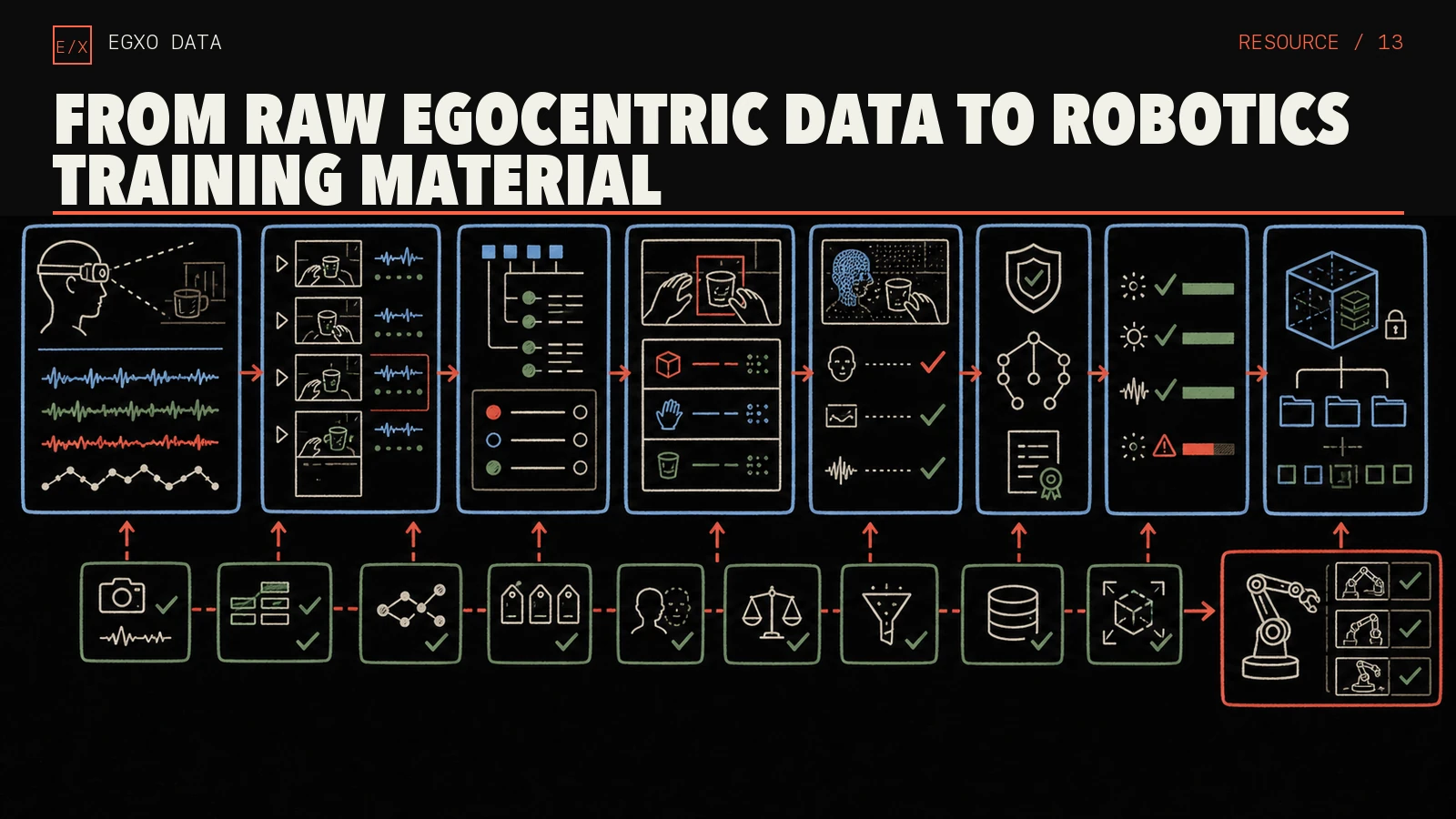
Raw Footage Is Evidence, Not Yet Training Data
Source-backed context[1] Project Aria data formats[3] Ego4D annotation guidelines[5] RLDS episode and step structure[6] LeRobotDataset v3 format
Egocentric recording captures activity from a camera moving with a person. It can preserve hands, objects, tools, task order, local state changes, mistakes, and recovery in real environments. Those signals can be valuable for robotics, but a folder of first-person videos is not a training-ready dataset. The files do not automatically explain which task was attempted, when an action began, whether the important contact was visible, how sensors align, what a label means, or what the robot should learn to predict.
The transformation is best understood as a controlled evidence pipeline: raw capture becomes trusted data; trusted data becomes structured episodes; episodes receive model-relevant supervision; human evidence is connected to an explicit robotics use; and the result is packaged, tested, and versioned for the consuming system. Each stage should produce reviewable records rather than relying on filenames, operator memory, or a generic high-quality label.
The 5 Parts of a Robotics Training Example
Source-backed context[5] RLDS episode and step structure[6] LeRobotDataset v3 format[7] Open X-Embodiment dataset structure
Whatever the final storage format, a useful training example normally combines five ingredients. The observation is what the model receives. Context explains the task and environment. The target defines what the model should predict. Validity records say which signals can be trusted. Provenance connects the example to its source and transformation history.
For a vision-language-action system, one example might contain a short window of RGB frames, a task instruction, robot state, the next robot action, masks for missing measurements, and episode identifiers. A task-understanding model might use the same frames and instruction but predict a subtask or object-state change instead. There is no universal conversion because training material is defined by the learning objective.
- Observation: RGB, depth, audio, IMU, gaze, pose, robot state, or a temporal window of several modalities
- Context: task instruction, environment, objects, viewpoint, embodiment, episode state, and relevant history
- Target: action, trajectory, subgoal, state change, future observation, success judgment, or semantic label
- Validity: missing-signal masks, confidence, uncertainty, quality status, and eligibility
- Provenance: source asset, collection protocol, annotation or model version, transformation, and release
Stage 1 — Define What the Robot Must Learn
Source-backed context[7] Open X-Embodiment dataset structure[8] RoboVQA human and robot embodiment study
The workflow begins with a model requirement, not a recording quota. The team defines the task, deployment environment, target embodiment, expected observation space, desired output, failure conditions, and evaluation claim. A model learning action recognition needs different evidence from a world model predicting object transitions or a policy producing executable controls.
Human egocentric data can support visual pretraining, task segmentation, language grounding, affordance learning, state-change prediction, world models, evaluators, or intermediate representations. It can also contribute to a joint human-and-robot program. The collection specification must name the intended route so camera placement, modalities, annotation granularity, negative examples, and robot-native requirements follow from a falsifiable hypothesis.
- What will the model observe at training and deployment time?
- What exactly should it predict, retrieve, score, or execute?
- Which task moments must be visible and at what temporal resolution?
- Which quantities must be measured, and which may be estimated or annotated?
- What downstream experiment will determine whether the data helped?
Stage 2 — Capture the Raw Egocentric Record
Source-backed context[1] Project Aria data formats[2] Project Aria timestamp definitions
A contributor performs representative tasks using a head-, glasses-, chest-, or wrist-mounted camera. Depending on the learning objective, the rig may also record audio, accelerometer and gyroscope measurements, depth, gaze, hand tracking, body pose, or synchronized external cameras. Project Aria documentation illustrates how a wearable system can represent cameras, IMUs, audio, and derived perception outputs as separate streams with their own identities, configurations, and timestamps.
The capture application should record more than the sensor samples. Device, mount, firmware, task, session, environment, protocol version, calibration event, instruction, attempt number, and stop or retry reason all become part of the evidence. These facts let later teams distinguish what was requested from what actually happened during a particular take.
- Raw modalities and sensor-specific configuration
- Stable contributor, session, take, task, device, and stream references
- Timestamps, clock source, sampling settings, and calibration references
- Protocol, instruction, environment, object set, attempt, and completion response
- Operational events such as restart, remount, battery change, interruption, or safety stop
Stage 3 — Securely Ingest and Preserve the Originals
Source-backed context[6] LeRobotDataset v3 format[9] MLCommons Croissant 1.1 metadata specification
Uploaded material enters controlled storage and receives stable identifiers, checksums, recorded file sizes, source relationships, and an ingest result. The original capture should remain immutable. Cropped, redacted, synchronized, transcoded, or clipped versions are new derived assets linked to the source rather than replacements for it.
This separation creates a chain of custody. A checksum proves whether a file changed. Stable relationships show which release, episode, annotations, and derived streams depend on it. Versioned provenance makes later corrections possible without silently changing the evidence under a previously trained model.
- Verify expected files, sizes, checksums, and companion-stream relationships
- Quarantine incomplete or unexpected uploads before downstream processing
- Store raw, working, approved, and buyer-export tiers separately
- Record every transformation with its inputs, outputs, method, version, and status
Stage 4 — Validate Media, Sensors, and Metadata
Source-backed context[1] Project Aria data formats[6] LeRobotDataset v3 format
A playable video can still be structurally unsuitable for training. Automated validators check complete decoding, duration, dimensions, orientation, frame rate, timestamps, sample counts, required metadata, duplicates, missing modalities, and referential integrity. Observed results remain separate from the settings requested by the capture protocol.
Every failed condition needs a defined disposition. Some records can be repaired without altering meaning, such as normalizing a documented container field. Others require a repeat because the model-relevant signal is gone. Silent coercion is dangerous: interpolating across a large sensor gap or guessing an episode boundary can make a release look complete while introducing false supervision.
- Accept: the record passes every required gate
- Repair: a documented, reversible transformation resolves the issue
- Repeat: the source evidence must be captured again
- Quarantine: eligibility or meaning remains unresolved
- Reject: the record cannot support the intended use
- Unverified: the project did not test the condition and does not imply that it passed
Stage 5 — Synchronize Time and Calibrate Geometry
Source-backed context[1] Project Aria data formats[2] Project Aria timestamp definitions
Robotics data is temporal. RGB, IMU, audio, depth, gaze, and external cameras commonly operate at different rates and may use different clocks. Synchronization places samples on one trustworthy timeline by documenting the time domain, units, clock source, offsets, drift, resets, gaps, and mapping between streams. Starting two devices at roughly the same moment is concurrent capture, not proof of synchronization.
Calibration explains geometry. Camera intrinsics, lens distortion, sensor extrinsics, IMU axes, coordinate frames, transform direction, units, image readout timing, and calibration error may be required to interpret pose, gaze, acceleration, trajectories, or multi-camera correspondence. A geometric value without a named frame and unit can parse correctly while remaining unusable.
- Validate offset and drift across representative long episodes, not only at the start
- Record dropped frames, missing sensor intervals, clock resets, and interpolation policy
- Bind each calibration to the correct device, mount, session, and validity interval
- Store residual alignment or calibration error instead of a vague synchronized flag
Stage 6 — Apply Privacy, Rights, and Release Controls
Source-backed context[4] Ego4D privacy and ethics[9] MLCommons Croissant 1.1 metadata specification
Egocentric cameras can capture faces, voices, screens, documents, addresses, reflections, bystanders, private rooms, and behavior unrelated to the task. Privacy controls therefore begin with capture minimization and continue through review, redaction, access, retention, incident handling, and release approval. Ego4D documents the use of consent, controlled environments, and de-identification within a large-scale egocentric program.
Permission to record is not automatically permission to annotate, provide vendor access, deliver to a buyer, train a commercial model, retain indefinitely, or publish publicly. Those decisions should be represented separately and connected to the exact assets and release. The training export should carry eligibility and policy references without spreading unnecessary identity into the model pipeline.
Stage 7 — Convert Continuous Activity Into Episodes and Steps
Source-backed context[5] RLDS episode and step structure[6] LeRobotDataset v3 format[7] Open X-Embodiment dataset structure
Robotics systems learn from sequences, transitions, and outcomes rather than arbitrary file boundaries. Recordings are organized into a hierarchy such as release, contributor session, take, task episode, step, and frame or sensor sample. RLDS defines reinforcement-learning datasets as episodes of ordered interaction steps; LeRobot similarly uses metadata to recover episode boundaries even when many episodes share larger Parquet and video shards.
One backpack-packing recording may contain several attempts. Each attempt can become an episode with its instruction, objects, environment, start and end, task outcome, interruption, retry relationship, and terminal state. Success, capture acceptance, privacy eligibility, and release approval remain separate. An unsuccessful attempt can be useful evidence, while a completed task can still fail because critical contact was hidden.
Stage 8 — Add Metadata and Model-Relevant Annotations
Source-backed context[3] Ego4D annotation guidelines[5] RLDS episode and step structure[6] LeRobotDataset v3 format[9] MLCommons Croissant 1.1 metadata specification
Metadata explains the record; annotations add interpretations that a model can consume. Depending on the objective, annotation may cover tasks, temporal action segments, narrations, transcriptions, objects, bounding boxes, masks, hands, contact, pose, object states, affordances, failures, and recovery. Ego4D’s benchmark documentation demonstrates how the same broad egocentric corpus can support temporally and spatially different supervision tasks.
Each label should retain its target asset or interval, ontology, guideline version, creation method, confidence, review status, and supersession history. Model-assisted pose, gaze, depth, trajectory, or annotation remains derived data. It should identify the model and configuration used and must not be presented as directly measured ground truth.
The correct granularity follows the training target. Retrieval may need clip-level labels. Procedure learning may need steps. Contact or manipulation may require event-level or frame-level supervision. Dense labeling without a defined consumer adds cost and disagreement rather than automatic quality.
Stage 9 — Bridge the Human-to-Robot Embodiment Gap
Source-backed context[7] Open X-Embodiment dataset structure[8] RoboVQA human and robot embodiment study
Human egocentric video preserves task structure, object use, local state changes, natural variation, mistakes, recovery, and language. Ordinary video does not inherently contain robot joint commands, end-effector controls, gripper state, force, torque, tactile signals, controller frequency, or a guaranteed mapping from human motion to the target robot.
The project therefore chooses an explicit transfer mechanism. Human video may support visual pretraining, task and subgoal discovery, object-state prediction, language grounding, trajectory estimation, simulation reconstruction, reward or evaluator learning, or joint training with robot-native episodes. RoboVQA reports that combining human and robot embodiments benefited robot-only evaluation for its grounded reasoning task, but that result does not make arbitrary human clips executable robot trajectories.
When a policy requires actions, robot-native data, teleoperation, retargeting, or another validated translation layer supplies the missing controls. Every estimated or retargeted action should preserve its method, coordinate conventions, uncertainty, and evidence that it is compatible with the target embodiment.
- Human evidence layer: diverse tasks, environments, procedures, language, state changes, and recovery
- Translation layer: correspondence, pose, trajectory, retargeting, simulation, learned representation, or evaluator
- Robot-native layer: executable actions, proprioception, embodiment constraints, contact, outcomes, and safety evaluation
Stage 10 — Measure Semantic Quality and Acceptance
Implementation guidanceEGXO guidance for translating the research into a project specification.
Technical validity proves that files and fields exist. Semantic QA determines whether the required learning signal is correct and observable. Reviewers assess task fidelity, critical-action visibility, occlusion, state changes, temporal boundaries, annotation meaning, synchronization, calibration, privacy, and rights eligibility.
A single quality score hides why an asset passed and prevents a later buyer from applying different thresholds. Store each check, observed value, threshold, rule version, sampled population, evidence, decision, reviewer role, and disposition. Recorded, uploaded, technically valid, annotation-approved, privacy-eligible, and release-approved should remain distinct states.
Stage 11 — Design Splits Without Leakage
Source-backed context[5] RLDS episode and step structure[6] LeRobotDataset v3 format
Accepted episodes are divided into training, validation, and test sets according to the generalization claim. Hold out contributors to test new people, environments to test new rooms, object families to test new objects, devices to test sensor robustness, or task combinations to test composition. The split unit must be documented and reproducible.
Randomly splitting nearby frames is usually misleading because adjacent frames, retries, and clips from the same session are highly correlated. Duplicate and near-duplicate detection should run before the split is finalized. Stable contributor, room, object, task, and session keys help prevent hidden overlap without exposing unnecessary identity to the training release.
Stage 12 — Package a Versioned Training-Ready Release
Source-backed context[6] LeRobotDataset v3 format[9] MLCommons Croissant 1.1 metadata specification
The approved records are converted into a format the buyer can load, such as LeRobot, RLDS, Parquet plus video shards, or a project-specific schema. LeRobot v3 separates high-frequency tabular signals, visual data, and metadata while using episode records to resolve task membership and offsets. Croissant provides a broader machine-readable description of dataset resources, structure, versioning, provenance, and usage conditions.
The canonical internal representation should remain separate from each buyer export. That permits a new loader, schema, or shard layout without losing the source relationships and quality evidence. A complete delivery includes the dataset card, schema, data dictionary, manifests, checksums, splits, calibration, synchronization, annotation guidance, quality results, lineage, rights summary, limitations, and version history.
Stage 13 — Prove the Release in the Real Training Loader
Source-backed context[5] RLDS episode and step structure[6] LeRobotDataset v3 format[7] Open X-Embodiment dataset structure
The final data acceptance test belongs in the consuming system. A representative release is loaded through the actual preprocessing and training stack. The team verifies video decoding, episode traversal, temporal sampling, sensor alignment, observation and target shapes, action conventions, coordinate frames, units, missing values, batching, augmentation, and split behavior.
This exposes mismatches that a collection dashboard cannot see. The dataset may be internally consistent yet fail because the buyer interprets timestamps differently, expects another action representation, cannot decode the selected codec, or crosses episode boundaries during temporal sampling. Run this test before collection scales, then record the loader, code version, sample population, and observed failures.
Stage 14 — Construct Model-Ready Batches
Source-backed context[6] LeRobotDataset v3 format[7] Open X-Embodiment dataset structure
At training time, the loader samples approved episodes and constructs model-ready examples. A vision-language-action batch might contain eight recent RGB frames, a task instruction, robot state, a synchronized sensor window, the next action, and masks for invalid measurements. A world model might use the same observation but predict a future frame or object state. An evaluator might predict success, failure, or the need for intervention.
Preprocessing may decode video, resize images, normalize numeric features, select temporal windows, map ontology values, pad variable-length sequences, and apply training-only augmentation. These transformations should be versioned and reproducible. Training augmentation is not part of the immutable source dataset and should not be confused with a permanent data correction.
Stage 15 — Feed Model Failures Back Into the Data Program
Implementation guidanceEGXO guidance for translating the research into a project specification.
Training is not the end of the data workflow. Model errors reveal missing coverage, poor observability, weak language alignment, annotation ambiguity, sensor drift, embodiment mismatch, or leakage. Those failures should be traced to the relevant tasks, environments, devices, contributors, ontology rules, and transformations.
The findings update the sampling plan, capture protocol, mount selection, sensor requirements, annotation guidelines, acceptance thresholds, or robot-native collection. Each approved change creates a new version rather than rewriting the historical release. The operational loop is collect, validate, structure, supervise, train, inspect failures, and collect better evidence.
Buy Accepted, Ingestible Episodes—not Recorded Hours
Implementation guidanceEGXO guidance for translating the research into a project specification.
Recorded hours measure activity, not training value. A useful commercial unit is an episode that exposes the required signal, passes technical and semantic checks, satisfies privacy and rights conditions, resolves through the schema, and loads correctly in the target pipeline. A smaller deliberately designed release can outperform a much larger archive that hides contact, lacks timing, leaks evaluation conditions, or cannot be mapped to the robot’s learning objective.
A buyer should ask for the transformation path, not merely the final folder: what was captured, what was inferred, what was annotated, what was measured, what failed, what was excluded, what remains unverified, and how the delivered examples connect to the model. Training readiness is the result of that evidence chain.
- Inspect representative raw, derived, accepted, rejected, and ambiguous examples
- Review the schema, annotation ontology, synchronization, calibration, and quality evidence
- Confirm the human-to-robot transfer hypothesis and robot-native requirements
- Test the proposed release in the intended loader before approving scale
- Price and plan around accepted, rights-eligible, ingestible episodes
Primary Sources and Further Reading
- [1] Project Aria data formats ↗
- [2] Project Aria timestamp definitions ↗
- [3] Ego4D annotation guidelines ↗
- [4] Ego4D privacy and ethics ↗
- [5] RLDS episode and step structure ↗
- [6] LeRobotDataset v3 format ↗
- [7] Open X-Embodiment dataset structure ↗
- [8] RoboVQA human and robot embodiment study ↗
- [9] MLCommons Croissant 1.1 metadata specification ↗
These sources inform the category-level guidance above. Project-specific requirements are defined with the buyer.