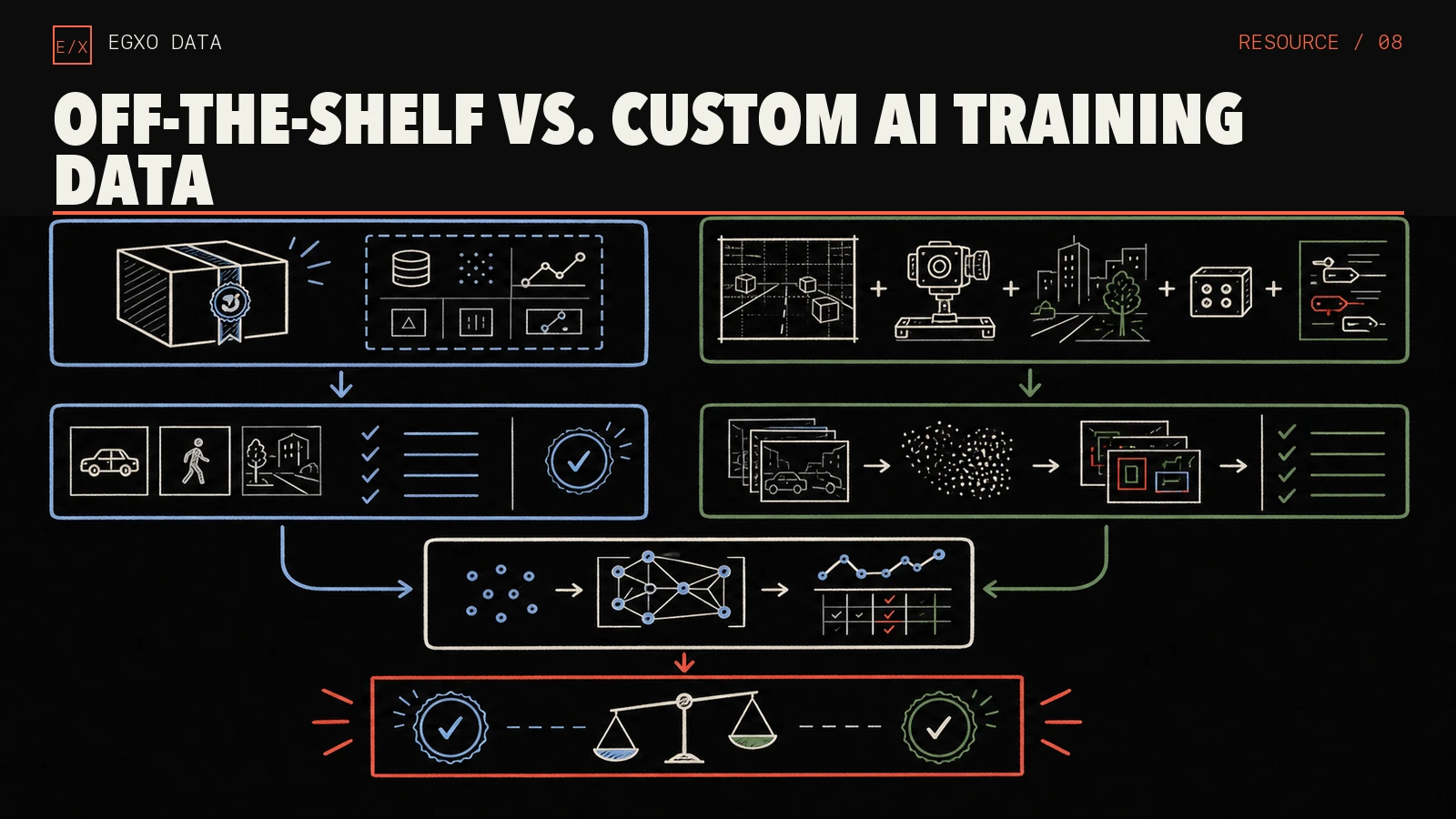
The Two Useful Buying Categories
Source-backed context[1] TELUS Digital data collection services[2] Appen off-the-shelf AI training datasets[3] Appen AI data collection services
In AI training data procurement, the useful commercial distinction is off-the-shelf data versus custom data collection. Off-the-shelf AI training data already exists and is offered under a defined license. Custom AI data collection creates a new dataset against a buyer’s task, contributor, environment, modality, annotation, quality, and rights requirements.
‘On-the-shelf data’ is not a reliable third category. A supplier may use the phrase to mean data that already exists, raw material in an archive, or a dataset that still needs filtering, annotation, quality review, or rights clearance. Treat it as ambiguous shorthand until the supplier states exactly what is complete and what remains to be done.
What Is Off-the-Shelf AI Training Data?
Source-backed context[2] Appen off-the-shelf AI training datasets
An off-the-shelf dataset is pre-existing data offered for licensing without commissioning a new collection program. A catalogue entry should describe the modality, volume, language or geography, contributor population where relevant, file and annotation formats, provenance, and license. Delivery can be faster because recruitment and recording have already occurred.
Ready to license does not necessarily mean ready for your model. The dataset may still require filtering, transformation, relabeling, split design, privacy review, or a new loader. It may also reflect tasks, environments, sensors, or demographics that differ from deployment. Evaluate usable fit rather than the headline number of hours, clips, frames, or records.
- Best for rapid baselines, benchmarking, common tasks, and additional training volume
- Usually offers less control over how, where, and from whom the data was collected
- Often licensed non-exclusively, although the actual contract controls
- Can be inexpensive to acquire yet costly to clean or adapt if fit is weak
What Is Custom AI Data Collection?
Source-backed context[1] TELUS Digital data collection services[3] Appen AI data collection services
Custom data collection produces data for a defined model objective and operating context. The buyer can specify tasks, objects, environments, participant criteria, viewpoints, hardware, modalities, metadata, annotation ontology, failure cases, acceptance thresholds, delivery structure, and permitted uses.
That control adds design and operating work. Recruitment, instructions, capture tooling, privacy controls, quality assurance, annotation, and release governance must be built around the specification. Custom collection is strongest when those details materially affect model behavior—not merely because proprietary data sounds strategically attractive.
- Best for proprietary workflows, rare conditions, deployment gaps, and controlled evaluation
- Provides more control over coverage and acceptance criteria
- Requires a pilot to test whether the specification produces usable signal
- Does not imply exclusivity or ownership unless the agreement says so
Do Not Confuse Off-the-Shelf With Public Data
Source-backed context[2] Appen off-the-shelf AI training datasets[4] Hugging Face dataset card documentation
Off-the-shelf describes commercial readiness, not public availability. A proprietary dataset can be pre-built and licensed privately. A public dataset can be downloadable yet restricted by its license, access terms, consent scope, or permitted uses. ‘Available online’ and ‘approved for commercial model training’ are different claims.
Review the dataset card, license, provenance, intended uses, limitations, and access conditions for every candidate source. If the documentation does not answer a material question, resolve it before placing the data in a training or evaluation pipeline.
Compare the Options Against Model Fit
Implementation guidanceEGXO guidance for translating the research into a project specification.
A procurement decision should start with the model’s missing signal, not the vendor’s inventory. Build a short coverage matrix and score every candidate source against the same requirements. This makes an off-the-shelf, custom, or hybrid decision comparable instead of rhetorical.
- Task fit: goals, actions, errors, recovery behavior, and terminal states
- Environment fit: geography, layout, lighting, clutter, objects, and operating conditions
- Capture fit: egocentric, exocentric, synchronized views, sensors, resolution, and timing
- Population fit: eligibility, experience, demographic coverage, and natural variation
- Label fit: ontology, temporal granularity, metadata, negatives, and adjudication
- Rights fit: training, evaluation, annotation access, retention, derived models, and redistribution
- Pipeline fit: codecs, schema, loaders, splits, versioning, and acceptance evidence
Physical AI Raises the Cost of a Poor Match
Implementation guidanceEGXO guidance for translating the research into a project specification.
For robotics and physical AI, visually similar recordings can contain very different training value. A clip may show the correct task but hide contact, omit the failure state, use the wrong viewpoint, or lack the timing and metadata needed to connect observation with action. Environmental geometry, embodiment, object properties, and long-horizon continuity can matter as much as semantic labels.
The relevant unit is not cost per recorded hour. Compare cost per accepted, rights-eligible, ingestible episode that exposes the signal required by the learning objective. This calculation can favor an existing dataset, a targeted custom collection, or a combination of both.
A Hybrid Strategy Often Wins
Source-backed context[1] TELUS Digital data collection services[2] Appen off-the-shelf AI training datasets
Use off-the-shelf data to establish a baseline quickly when it passes the initial fit and rights review. Test the model in representative deployment conditions, identify weak slices and missing behaviors, then commission custom training data for those gaps. The existing dataset supplies speed and breadth; the custom program concentrates spend on differentiation and failure reduction.
Keep provenance separate when sources are combined. Record which examples came from each license, how they were transformed, which splits contain them, and whether downstream distribution or model use differs by source.
Questions to Ask Before Buying AI Training Data
Source-backed context[4] Hugging Face dataset card documentation
Ask for evidence that can be reviewed, not adjectives such as diverse, production-ready, or high quality. A useful procurement packet makes the dataset’s contents, creation process, limitations, license, and release version explicit.
- Does the data already exist, and can representative samples be inspected now?
- Which collection, annotation, privacy, and quality steps are complete?
- What tasks, environments, contributors, devices, and failure cases are covered?
- Which rights are granted for training, evaluation, derived models, retention, and third-party access?
- Is the dataset exclusive, non-exclusive, or subject to supplier reuse?
- What transformations or custom work remain before delivery?
- Can a representative sample pass the intended loader and acceptance tests?
Choose With a Pilot, Not a Label
Implementation guidanceEGXO guidance for translating the research into a project specification.
If an existing dataset appears suitable, validate a sample in the real pipeline before licensing the full release. If custom collection is required, run the smallest pilot that tests task visibility, protocol execution, rights, quality, schema, and ingest. In both cases, the decision should end with measured evidence and a written record of unresolved gaps.
EGXO’s public clips are previews from existing egocentric data products, not the complete licensed delivery. Qualified buyers can request pricing and controlled access to available datasets, then commission custom collection where the task, environment, modality, annotation, scale, or rights do not match.
Primary Sources and Further Reading
- [1] TELUS Digital data collection services ↗
- [2] Appen off-the-shelf AI training datasets ↗
- [3] Appen AI data collection services ↗
- [4] Hugging Face dataset card documentation ↗
These sources inform the category-level guidance above. Project-specific requirements are defined with the buyer.