Robot Learning / approximately 10 min
Vision-Language-Action ModelVLA
Learn how a vision-language-action model turns images and instructions into robot actions, which episode fields it needs, and where human demonstrations fit.
Direct definition
What Is Vision-Language-Action Model?
A vision-language-action model, or VLA model, is a robot policy that takes visual observations, a language instruction, and often robot state, then predicts an action or action chunk in a defined control space. It extends a vision-language model from describing or reasoning about a scene to issuing commands intended for a robot to execute.
Plain-language analogyA vision-language model can explain how to put a cup on a drying rack. A VLA must turn that understanding into correctly timed movements for a particular robot.
01
VLM vs. VLA: The Output Changes the System
Source-backed context[1] Google DeepMind RT-2 project and paper[2] OpenVLA open-source vision-language-action model[3] Physical Intelligence pi0 vision-language-action flow model
Both model families can interpret images and language. The boundary is what the model produces. A vision-language model may identify an object, answer a question, or describe a next step. A VLA produces an action representation intended to control a physical system, such as joint targets, Cartesian end-effector deltas, gripper commands, or action chunks.
The model is usually used in a feedback loop. It receives the current observation and instruction, predicts the next action or short action sequence, lets the controller execute it, then observes the result. RT-2 represented actions as tokens that could be decoded into robot controls. Other systems, including the pi0 family, use continuous action generation for higher-frequency control.
- Typical inputs: RGB or video, language instruction, robot state, and recent temporal context
- Typical outputs: action tokens, joint targets, end-effector commands, gripper state, or continuous action chunks
- Execution context: a defined robot body, controller, coordinate frame, control rate, and safety layer
02
Required Fields in a Model-Facing Episode
Source-backed context[4] Open X-Embodiment dataset and RT-X models[5] LeRobotDataset v3 format
A usable episode connects the task instruction, observations available to the policy, embodiment state, selected actions, and resulting outcome on one timeline. It also records episode boundaries, task and environment context, valid masks, split lineage, and provenance. A folder containing video, captions, and a separate action file is not sufficient if those streams cannot be aligned deterministically.
Action meaning is embodiment-specific. The same behavior can be encoded as joint positions on one platform, Cartesian end-effector motion on another, or a learned action chunk on a third. Units, axes, control frequency, coordinate frames, gripper conventions, normalization, and interpolation rules must be explicit. Otherwise the action field is only an array of numbers.
- Instruction and task: goal, constraints, task identifier, optional step labels, and completion rule
- Observation: RGB, depth, tactile, force, audio, or other model-visible inputs
- State: joints, gripper, pose, velocity, and other proprioceptive signals
- Action: command representation, frequency, units, axes, frame, normalization, and valid masks
- Outcome and governance: success, failure, recovery, termination, provenance, rights, and version
03
Where Human and Egocentric Demonstrations Fit
Source-backed context[2] OpenVLA open-source vision-language-action model[4] Open X-Embodiment dataset and RT-X models[6] Google DeepMind RoboVQA human and robot embodiment study
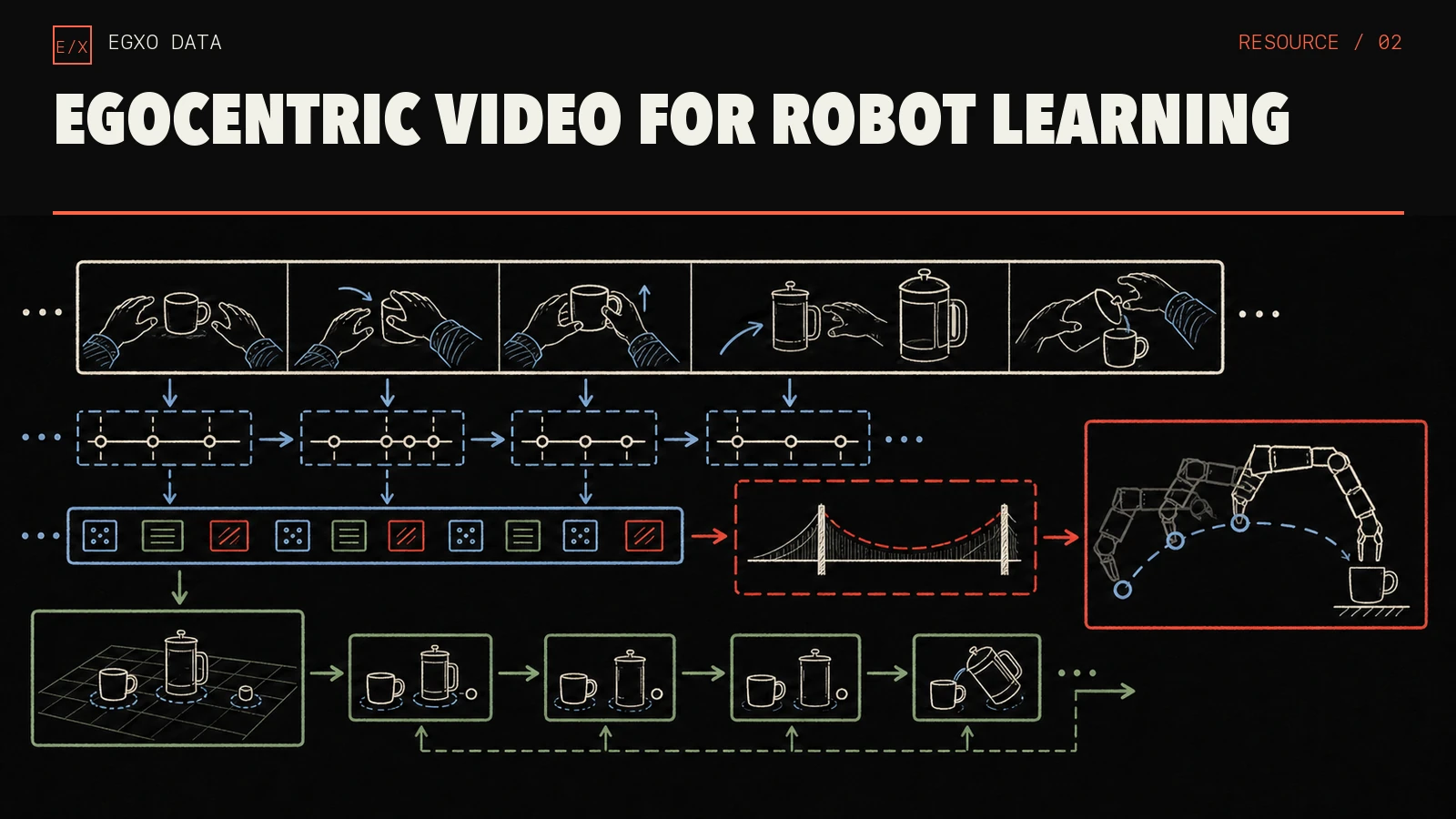
Human and egocentric demonstrations can expand coverage of tasks, objects, environments, corrections, and natural behavior before every example is available on a robot. They can support visual pretraining, task and subgoal discovery, hand-object understanding, affordance learning, language grounding, evaluator learning, and long-horizon sequence modeling.
They are not robot-executable action supervision by default. A human hand and a robot gripper differ in geometry, dynamics, sensing, reach, force, and control space. A credible program therefore names the translation layer, such as representation learning, hand or object pose estimation, contact mapping, retargeting, paired human and robot views, simulation reconstruction, or robot-native adaptation. It then validates the result on the target robot.
The collection specification should state which human-visible signals matter, how they will be derived, and which claim they support. If the goal is direct policy learning, the program must also define where robot state and control targets come from. Calling human video a robot action record without that bridge is technically false.
04
Common VLA Data Pipeline Failure Modes
Source-backed context[1] Google DeepMind RT-2 project and paper[4] Open X-Embodiment dataset and RT-X models[5] LeRobotDataset v3 format
VLA data pipelines fail quietly when streams look complete but cannot be aligned. Typical defects include timestamp drift, actions stored at another frequency without valid interpolation, frames missing during contact, state vectors with undocumented ordering, control values normalized without the inverse transform, instruction drift, and success labels that disagree with the final scene.
Coverage errors can be just as damaging. Repeating clean successes in one setup can produce a policy that breaks under clutter, changed lighting, alternate objects, left-handed execution, recovery states, or small control errors. Evaluation should hold out the unit of generalization being claimed, such as environments, objects, tasks, or operators, rather than random frames from the same sessions.
- Observation-action misalignment
- Undocumented action spaces, normalization, or coordinate frames
- Missing recovery and failure examples
- Instruction drift across annotators
- Train-test leakage across scenes, episodes, objects, or operators
- Human video represented as executable robot control without validation
05
Buyer Guidance for a VLA Demonstration Program
Implementation guidanceEGXO guidance for translating the definition into a project specification.
Start with the model-facing example rather than a camera count or requested number of hours. Define what the policy receives, what it predicts, the target robot, the required task distribution, and how success will be evaluated. Then select human, egocentric, synchronized ego-exo, simulation, teleoperation, or robot-native sources that can produce the required signals.
For a human-demonstration program, require a pilot that passes through the intended preprocessing and model loader. Review visibility, temporal alignment, annotation agreement, rights, derived signals, and the proposed embodiment bridge. Scale only after the pilot proves that accepted episodes are usable for the stated training or evaluation role.
- Target model architecture, observation window, and output representation
- Robot embodiment, action space, control rate, units, coordinate frames, and controller boundary
- Task, object, environment, and failure coverage
- Synchronization, calibration, and missing-data tolerances
- Learning role and validated translation layer for each human-demonstration signal
- Episode split, rights, provenance, delivery, and versioning requirements
- Pilot acceptance test in the actual preprocessing, loader, and evaluation path
Quick answers
Frequently Asked Questions
What is a VLA model?
A VLA model is a robot policy that uses visual observations and a language instruction, often together with robot state, to predict actions in a defined robot control space.
How is a VLA different from a VLM?
A vision-language model usually returns text, labels, or other semantic predictions. A VLA produces action representations intended to control a robot, so its data must connect observations and instructions to timed state, actions, and outcomes.
Can egocentric human video train a VLA model?
It can support visual pretraining, task decomposition, language grounding, affordance learning, evaluation, and other forms of supervision. It is not robot-executable control data unless the program adds and validates a translation layer or robot-native adaptation path.
What should a VLA human-demonstration pilot include?
The pilot should define the target model and robot, task and environment coverage, viewpoints, timing, required derived signals, rights and provenance, the human-to-robot translation method, and an end-to-end acceptance test in the intended loader or evaluation pipeline.
Research basis
Primary Sources and Further Reading
- [1] Google DeepMind RT-2 project and paper ↗
- [2] OpenVLA open-source vision-language-action model ↗
- [3] Physical Intelligence pi0 vision-language-action flow model ↗
- [4] Open X-Embodiment dataset and RT-X models ↗
- [5] LeRobotDataset v3 format ↗
- [6] Google DeepMind RoboVQA human and robot embodiment study ↗
The sources establish the technical context. The buyer requirements are EGXO guidance for converting that context into a testable data specification.