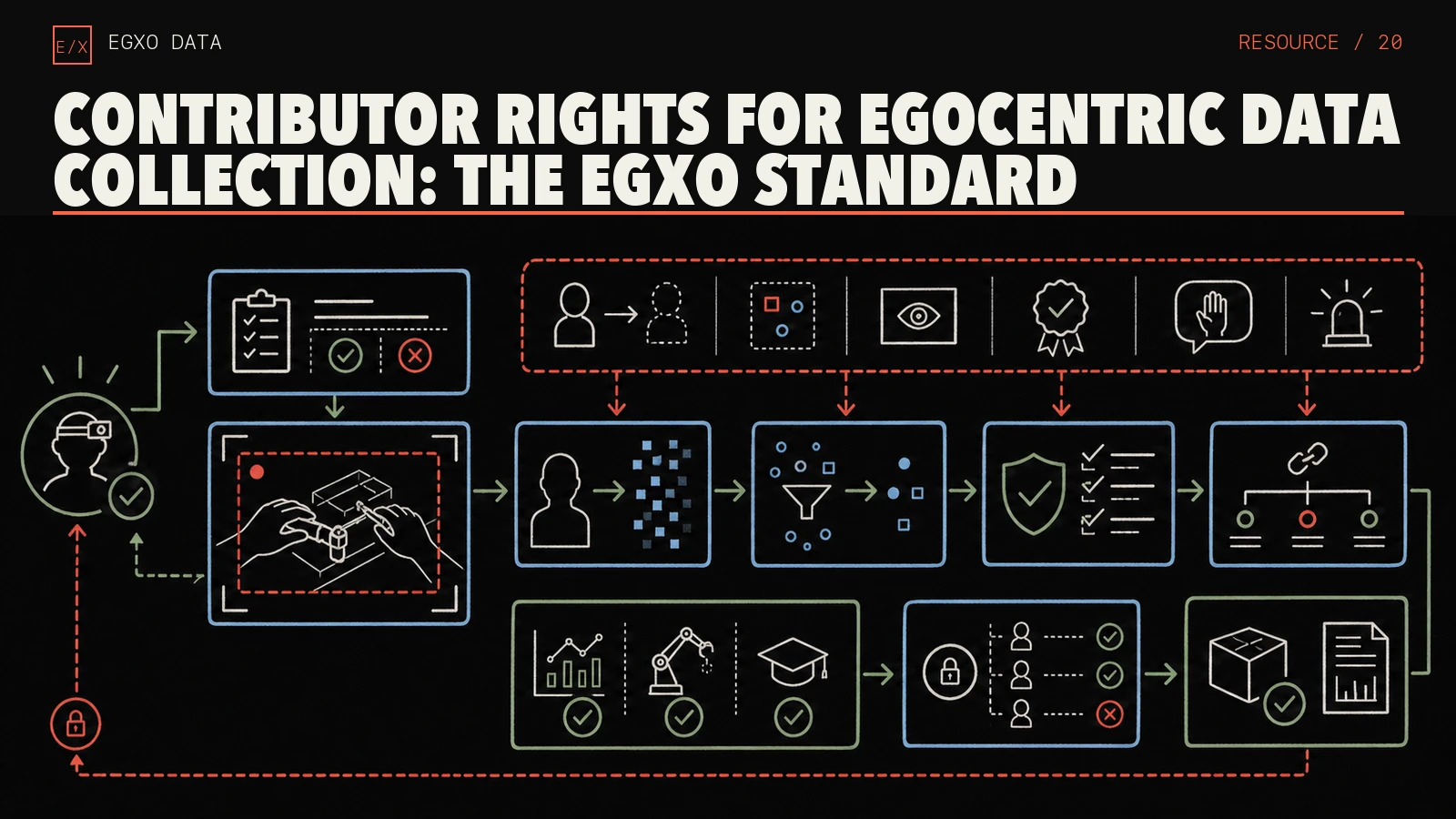
Seven Rights Gates Before Buyer Delivery
| Gate | Required evidence | Release decision |
|---|---|---|
| Project disclosure | Task, location, capture, purpose, reviewers, exclusions, and reward basis shown before recording | Block if the intended use exceeds the project disclosure |
| Participation and compensation | Program terms plus a record that distinguishes business payment from individual worker compensation | Block unsupported contributor-pay claims |
| Privacy and capture scope | Approved site, participants, devices, task, and excluded people or information | Reject or remediate out-of-scope capture |
| Acceptance record | Submission status, material rejection reason, reward basis, and remediation history | Only accepted records proceed |
| Permitted use | Model training, commercial use, public display, vendors, redistribution, retention, and geography | Approve only the uses explicitly supported |
| Rights requests | Request route and documented source, distribution, retention, and trained-model limits | Never promise deletion beyond enforceable control |
| Legacy review | Pinned source agreement, intended use, contributor category, buyer terms, and surviving restrictions | No new license without a release-specific decision |
This Is a Prospective Minimum, Not Retroactive Consent
Source-backed context[1] GIG Rewards AI data information[2] EGXO legal operator and collection provenance[3] GIG Rewards privacy policy
The standard applies to newly scoped EGXO collection from July 25, 2026 and to any legacy asset newly approved for licensing. It does not rewrite historical agreements. A legacy dataset must pass a fresh, release-specific review before buyer delivery.
That boundary matters. Saying a company owns or licenses media is not enough to prove every new training, commercial, public-display, vendor, or redistribution use. The release decision must pin the agreement and the intended use.
EGXO Data and GIG Rewards Share One Legal Operator
Source-backed context[2] EGXO legal operator and collection provenance
EGXO Data and GIG Rewards are operated by the same legal entity, 10xme Technology Inc. The same organization runs the contributor network, data operation, and contracting process, including programs operated with telco partners.
That shared ownership establishes operational provenance; it does not eliminate release-specific rights checks. Each buyer delivery must still pin the applicable contributor terms, collection authority, model-training and commercial use, public-display approval, vendor access, redistribution, retention, and surviving restrictions.
Disclosure Must Be Project-Specific
Source-backed context[1] GIG Rewards AI data information
Before recording, the project brief should state what is captured, where, for which task, for what AI or robotics purpose, who may review it, how acceptance and reward work, and what must stay out of frame. Participation in one task cannot silently authorize another.
GIG’s public AI-data guidance already tells contributors to follow the current quest, limit the recording to the task, avoid unrelated people and sensitive information, review the recording, and understand that approval depends on acceptance.
Business Payment and Worker Compensation Are Different Claims
Source-backed context[2] EGXO legal operator and collection provenance
In a collection-partner program, EGXO or GIG may contract and pay a business. The business may then compensate participating workers under its employment arrangements and applicable law. A public business rate is not proof of the amount an individual worker received.
The release record should preserve that distinction. Reporter, buyer, and marketing materials must never collapse a business payment into an unsupported contributor-pay claim.
Privacy Exclusions Belong in the Capture Brief
Source-backed context[1] GIG Rewards AI data information[2] EGXO legal operator and collection provenance[3] GIG Rewards privacy policy
Approved locations, participants, devices, and tasks must be defined before collection. Unrelated people, private spaces, screens, documents, customer information, and sensitive content are excluded unless the brief expressly permits them and the necessary authorization exists.
Privacy review is not merely a blur pass at the end. The first control is to avoid collecting what the project does not need.
Rights Eligibility Is Independent of Technical Quality
Implementation guidanceEGXO guidance for translating the research into a project specification.
A record can pass focus, codec, synchronization, and annotation checks and still fail licensing. The dataset ledger must keep a rights status separate from technical QA and include collection authority, commercial and model-training permission, public-display status, vendor access, redistribution, retention, and restrictions.
The buyer sees a rights matrix, review date, agreement version, approval status, and provenance chain. Private identity documents, contact data, consent records, and confidential commercial terms remain controlled.
Rights Requests Need Honest Downstream Limits
Source-backed context[3] GIG Rewards privacy policy[4] Philippines National Privacy Commission — Know Your Rights[5] South Africa Information Regulator — POPIA
The program must provide a privacy or rights-request route. The response should explain what can be removed or restricted in source systems and what may already be governed by legal retention, a buyer agreement, a distributed copy, or a trained-model limitation.
Blanket deletion promises are worse than precise limits because they create an expectation the system cannot enforce. The operational record should say what happened, when, under which authority, and which downstream parties were notified where required.
The Buyer Release Gate
Implementation guidanceEGXO guidance for translating the research into a project specification.
No record enters a commercial buyer release until the seven gates above resolve for that specific release. The decision is versioned so later changes to purpose, geography, buyer, model use, or public display trigger a new review instead of inheriting an old yes.
- Rights-cleared is a release status, not a permanent adjective
- Legacy media receives a new decision before a new use
- Rejected and restricted records remain outside delivery
- Technical QA and rights QA report separately
- Private contributor evidence stays private
Primary Sources and Further Reading
- [1] GIG Rewards AI data information ↗
- [2] EGXO legal operator and collection provenance ↗
- [3] GIG Rewards privacy policy ↗
- [4] Philippines National Privacy Commission — Know Your Rights ↗
- [5] South Africa Information Regulator — POPIA ↗
These sources inform the category-level guidance above. Project-specific requirements are defined with the buyer.