Quote-ready evidence
Key Statistics
Use these figures with the named source and dated methodology. Published scale is not the same as usable training yield.
- 257/257videos successfully probed
Every indexed media record decoded during the authorized audit window. Source [1]
- 6/6bidirectional joins passed
No orphan records across file, metadata, task, and source-mapping tables. Source [1]
- 35.0%within 1 fps of declared rate
Only 90 of 257 records closely matched the declared frame rate. Source [1]
- 42.4%off by more than 5 fps
109 records materially disagreed with declared frame-rate metadata. Source [1]
- 59.4%tasks with at most two records
38 of 64 task labels reveal a long-tail coverage problem. Source [1]
- 238 IDspseudonymous source identifiers
The audit does not claim these IDs equal 238 unique people. Source [2]
The Package Is a Credible Evaluation Asset
Source-backed context[1] EGXO public aggregate metrics and evaluation report[2] EGXO evaluation methodology and privacy boundary
The evaluated package contains 257 videos, 10.0 hours of recorded media, 56.223 GiB, 64 task labels, 238 unique source IDs, and four structured tables. Every media record was accessible and successfully probed during the authorized audit window. All six bidirectional joins across file, metadata, task, and source-ID tables passed without orphan records.
That makes the package useful for buyer evaluation, loader testing, taxonomy review, annotation design, and targeted pilots. It does not make the package a universal robot-policy dataset. RGB video does not inherently contain joint state, end-effector commands, rewards, force, depth, or synchronized IMU.
Structural Integrity Is Strong
Source-backed context[1] EGXO public aggregate metrics and evaluation report
The files, metadata, and source-mapping tables each contain 257 rows; the task table contains 64. The audit found no missing cells or duplicate primary keys in the four tables, and no join orphans in either direction.
A clean relational package proves that records can be reconciled. It does not prove task-label correctness, critical-action visibility, contributor uniqueness, or model usefulness. Those require separate evidence.
All Media Probed Successfully, but the Streams Vary
Source-backed context[1] EGXO public aggregate metrics and evaluation report
The package contains 227 H.264 records and 30 HEVC records. Audio is present as one stream in 244 records, absent in 11, and present as two streams in two records. Record duration ranges from 5 to 1,356 seconds, with a 95-second median.
Mixed codecs and audio layouts are manageable when the delivery contract names the accepted profiles. They become pipeline defects when the buyer discovers them during training. A release should either normalize them or preserve them with explicit loader tests and missing-stream policies.
Duration, Dimensions, and Size Agree; Frame Rate Does Not
Source-backed context[1] EGXO public aggregate metrics and evaluation report
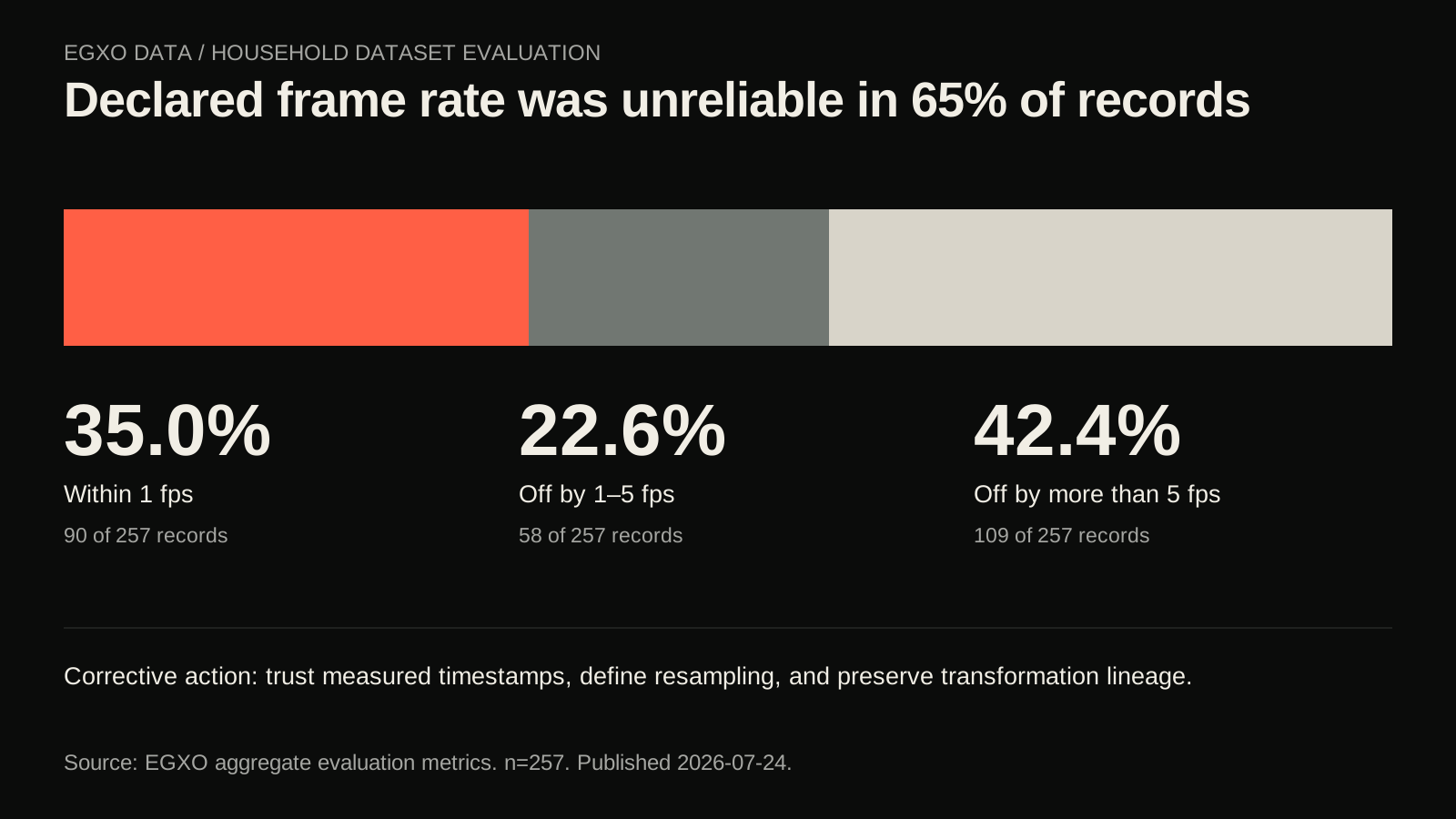
All 257 measured durations were within one second of the declared value. Displayed dimensions and byte sizes matched for every record. Only 90 records, or 35.0%, were within 1 fps of the declared frame rate. A total of 109 records, or 42.4%, differed by more than 5 fps. Median absolute error was 3.012 fps and the maximum was 36.195 fps.
The correct remediation is to treat decoded timestamps and measured stream properties as authoritative, define the target sampling policy, and record any transcode as a derived asset with checksums and lineage. Replacing everything with a guessed standard rate would hide the defect instead of fixing it.
Task Breadth Exceeds Task Depth
Source-backed context[1] EGXO public aggregate metrics and evaluation report
The 64 labels offer breadth across household activity, but 23 tasks have one record and 38 tasks have two or fewer. This is enough to explore a taxonomy and select high-value directions. It is not enough to claim robust within-task generalization across the long tail.
The next collection round should set minimum accepted episodes for buyer-priority tasks and balance object, environment, contributor group, viewpoint, outcome, and difficulty. Failures and recovery should be collected deliberately rather than treated as noise.
Source IDs Are Not Automatically Unique People
Source-backed context[1] EGXO public aggregate metrics and evaluation report
The package contains 238 unique source IDs. Seventeen IDs appear on more than one indexed row, covering 36 rows, with a maximum of four rows attached to one ID. This may be operationally legitimate, but contributor-level split claims require a resolved identity policy.
Public files contain no source IDs or direct identifiers. Buyer evaluation should preserve pseudonymous group separation only at the minimum level needed for leakage control, rights administration, and withdrawal handling.
Public Evidence Is Deliberately Limited
Source-backed context[1] EGXO public aggregate metrics and evaluation report[3] EGXO approved public household sample gallery
Five deterministic, task-spanning midpoint frames were reviewed during the audit and all five showed an egocentric viewpoint. The current public library separately presents five sanitized 15-second phase montages and one 10-second continuous excerpt selected for first-person framing, visible hands and objects, task progression, commercial relevance, privacy suitability, and readability.
The six previews have explicit public-marketing approval. They demonstrate real capture without exposing private records. They are not a statistical visual-quality sample and do not grant public model-training, redistribution, or bulk-download rights.
The Historical Audit Is Traceable, but Not Yet Independently Rerunnable
Source-backed context[2] EGXO evaluation methodology and privacy boundary[5] EGXO household audit provenance manifest
The executed audit code, notebook, result JSON, and calculation notes are preserved with SHA-256 checksums. The original 257-record archive was not retained with a recorded checksum, its authorized media links have expired, and the five reviewed midpoint frames were not retained. The reported aggregates can be traced to the executed artifacts, but the raw audit cannot currently be rerun independently.
A later controlled EGXO package is not automatically the same source snapshot. Full revalidation requires the exact archive or a version-matched 257-record manifest, renewed controlled media access, archive and manifest checksums, a complete rerun, and a private reviewer log with deterministic record IDs, timestamps, and privacy-controlled visual evidence.
Rights Exist, but the Delivery Must Carry the Proof
Source-backed context[1] EGXO public aggregate metrics and evaluation report[2] EGXO evaluation methodology and privacy boundary
The site owner confirmed that the underlying EGXO dataset is owned and rights-cleared. The original audit package did not embed a complete buyer-facing rights and consent packet. Those facts can coexist: operational rights may exist while the evaluated artifact still lacks the documentation a procurement team needs.
A controlled release should carry collection authority, permitted use, commercial and model-training status, vendor access, redistribution, retention, deletion, withdrawal, public-display, and transformation-lineage records without exposing private contributor documents.
Readiness by Intended Use
Source-backed context[1] EGXO public aggregate metrics and evaluation report[4] EGXO egocentric episode specification
The package is suitable now for controlled buyer evaluation, loader tests, taxonomy review, qualitative coverage analysis, annotation pilots, and public proof through approved clips. RGB representation learning, task segmentation, language alignment, and object-state analysis need normalized stream metadata, episode rules, annotation specifications, QA gates, versioning, and a validated ingest.
The current evidence does not support claims of robot-native actions, calibrated 3D pose, synchronized IMU, depth, force, tactile data, unbiased population performance, or unrestricted redistribution. Missing modalities must remain missing until a measured source exists.
- Normalize measured frame-rate and stream metadata
- Prioritize sparse buyer-relevant tasks instead of adding indiscriminate hours
- Define model-facing annotations and acceptance gates
- Package rights and provenance evidence with the release
- Test one complete delivery in the buyer’s actual loader
- Report acceptance rates and failure modes by task and variation slice
Primary Sources and Further Reading
- [1] EGXO public aggregate metrics and evaluation report ↗
- [2] EGXO evaluation methodology and privacy boundary ↗
- [3] EGXO approved public household sample gallery ↗
- [4] EGXO egocentric episode specification ↗
- [5] EGXO household audit provenance manifest ↗
These sources inform the category-level guidance above. Project-specific requirements are defined with the buyer.