Camera Placement Changes the Dataset
Source-backed context[1] Ego4D dataset and capture overview[2] EgoTracks object-tracking documentation
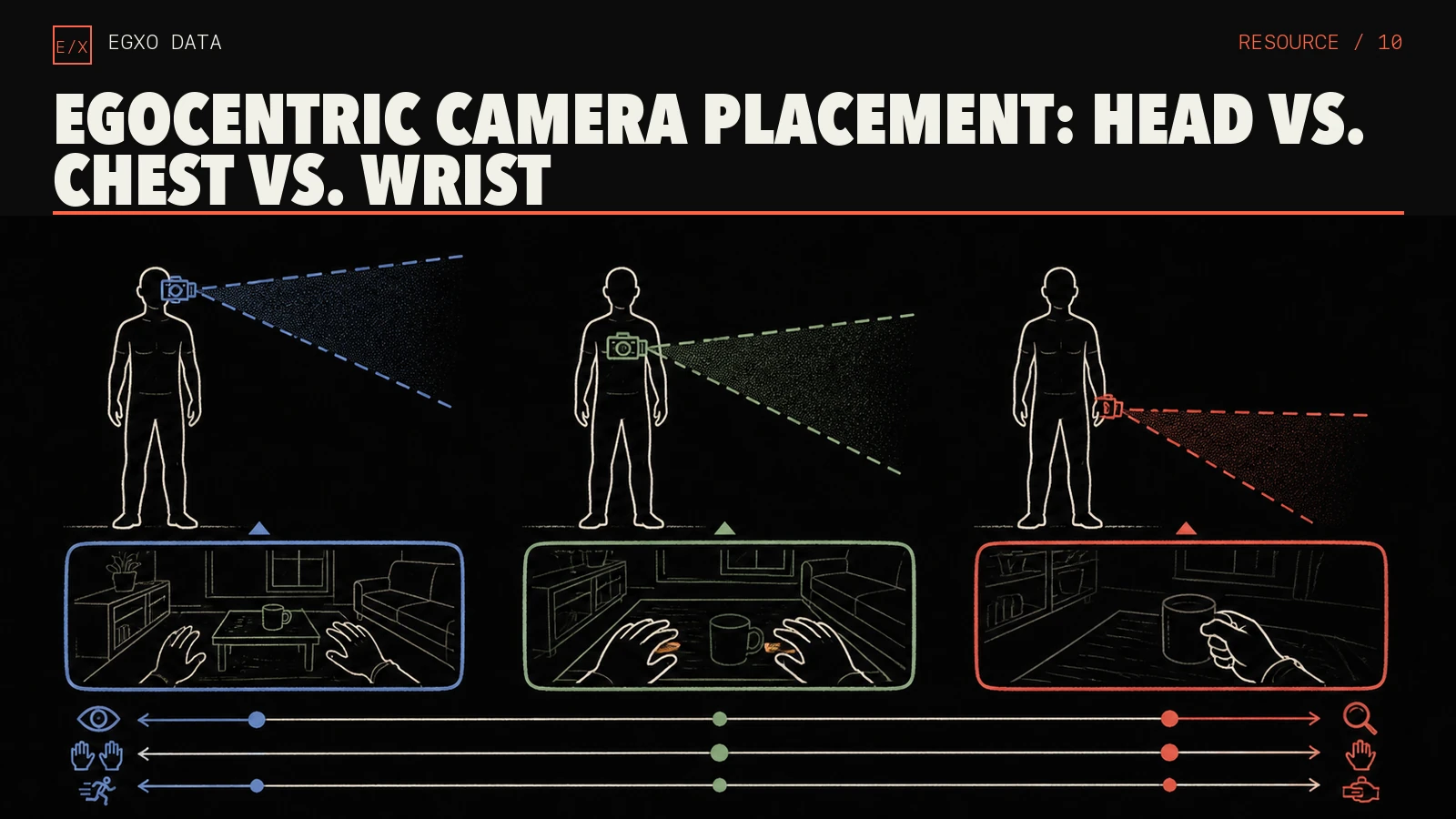
A camera mount determines which hands, objects, surfaces, people, and scene regions enter the dataset. It also changes motion, occlusion, comfort, privacy exposure, and how closely the view resembles the target model’s observation. A head-mounted camera can follow viewing direction; a chest camera can reduce some head motion; a wrist camera can move close to contact. None is universally best.
Large public resources such as Ego4D show the breadth possible with head-mounted cameras, while their tracking documentation also highlights rapid appearance change, camera motion, occlusion, and objects leaving frame. Those are design conditions to measure, not defects that can be wished away after collection.
Head-Mounted Cameras Follow the Actor’s Orientation
Source-backed context[1] Ego4D dataset and capture overview
Head mounts often keep the working area near the direction the actor is facing and can preserve broader context during mobile or long-horizon tasks. They also inherit head turns, nods, walking motion, self-occlusion, and moments when the actor looks away while the hands continue working.
- Test whether both hands remain visible during reach, contact, and placement
- Measure motion blur and horizon change during natural head movement
- Check comfort, fit, slippage, and camera angle across body types
- Verify whether the target robot has an observation compatible with a moving head view
Glasses-Mounted Cameras Can Approximate Eye-Level View
Implementation guidanceEGXO guidance for translating the research into a project specification.
Glasses mounts can place the lens near the eyes with less visual separation than some head rigs. They may improve comfort or natural behavior for certain tasks, but fit, lens offset, prescription eyewear, hair, lighting, battery, recording indicators, and gaze assumptions require care. A glasses camera still records camera direction, not verified human attention unless a calibrated gaze stream is present.
Chest-Mounted Cameras Trade Attention Alignment for Stability
Implementation guidanceEGXO guidance for translating the research into a project specification.
Chest placement can produce a steadier horizon and keep the hands in frame during tabletop work, but the torso may face somewhere different from the head or active workspace. Arms, clothing, countertops, and tall objects can block the view. The angle also changes with body shape, posture, seated work, and task height.
- Pilot standing, seated, bending, and reaching postures
- Check near-field coverage when hands work close to the torso
- Test work surfaces above and below the usual mounting angle
- Measure the percentage of critical events visible without asking contributors to pose unnaturally
Wrist-Mounted Cameras Reveal Contact but Lose Context
Implementation guidanceEGXO guidance for translating the research into a project specification.
A wrist view can bring manipulated objects, tools, and contact events close to the lens. It also rotates rapidly, can be blocked by the hand or object, may show only one side of a bimanual task, and can make global task state difficult to recover. It is usually a deliberate supplementary or robot-compatible viewpoint, not a default replacement for broader scene coverage.
The reviewed EGXO commercial wrist example pairs right- and left-wrist ego cameras with frontal and wide exo views. The wrist streams preserve near-field manipulation while the external streams retain body and workspace context. Its manual visual alignment is suitable for paired review within an estimated 500 ms tolerance, not calibration-grade sensor fusion.
Robot-Mounted Cameras Need Separate Validation
Source-backed context[3] Open X-Embodiment robot dataset structure
Robot-native datasets can use workspace, head, shoulder, wrist, or in-hand cameras alongside action and state. The observation and action spaces should match the target training code. Do not label a human chest or wrist view robot-native merely because its position sounds similar; optics, kinematics, timing, occlusion, and control remain different.
Run a Mount Selection Pilot
Implementation guidanceEGXO guidance for translating the research into a project specification.
Record the same representative tasks with candidate mounts and score the full videos rather than selected frames. Include normal executions, awkward workspaces, different people, dominant hands, hard occlusions, movement between stations, mistakes, and recovery. Keep each camera’s setup, cost, comfort, privacy, and review burden in the decision.
- Critical-action visibility rate by mount and task
- Hand, object, body, and workspace coverage where required
- Occlusion frequency and longest model-relevant gap
- Motion, focus, exposure, horizon, and framing failures
- Contributor comfort, safety, setup repeatability, and protocol drift
- Storage, synchronization, annotation, and privacy cost per accepted episode
Choose the Smallest Viewpoint Set That Proves the Signal
Implementation guidanceEGXO guidance for translating the research into a project specification.
Select one primary mount when it satisfies the learning objective and acceptance threshold. Add a second ego or exo view only when it contributes unique observable information worth the extra calibration, storage, privacy, annotation, and QA work. Document the rejected alternatives and known blind spots so later teams do not mistake a pilot decision for a universal rule.
Primary Sources and Further Reading
- [1] Ego4D dataset and capture overview ↗
- [2] EgoTracks object-tracking documentation ↗
- [3] Open X-Embodiment robot dataset structure ↗
These sources inform the category-level guidance above. Project-specific requirements are defined with the buyer.