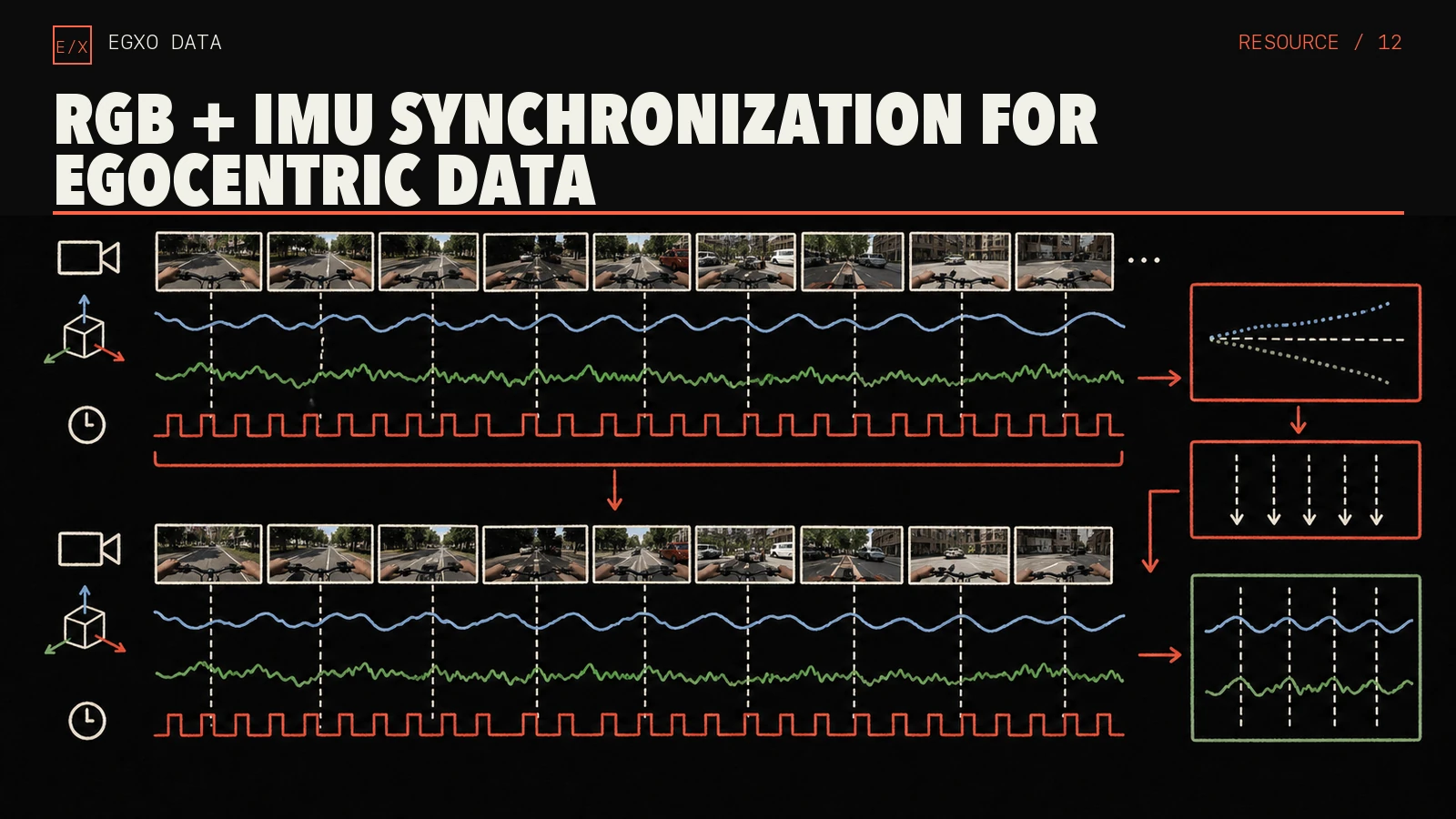
What RGB + IMU Synced Means
Source-backed context[1] TUM Visual-Inertial Dataset[2] EuRoC MAV Dataset
RGB + IMU synced means that color-camera frames and inertial measurements can be located on one trustworthy timeline. RGB records visible appearance and scene change. The inertial measurement unit records accelerometer and gyroscope samples that describe specific force and angular velocity along defined sensor axes. Synchronization lets a consuming system associate what the camera saw with how the capture device was moving at that time.
The streams usually run at different rates. A camera may produce tens of frames per second while an IMU produces hundreds of measurements per second. Synced therefore does not mean one IMU row per frame. It means every measurement has a timestamp in a shared or precisely mapped timebase, so software can select, interpolate, or integrate the inertial samples around each image exposure.
What Each Stream Contributes
Source-backed context[1] TUM Visual-Inertial Dataset[2] EuRoC MAV Dataset
RGB provides texture, color, objects, hands, tools, surfaces, and visible state changes. IMU measurements provide high-rate evidence of camera rotation, acceleration, vibration, and motion between video frames. Together they can support visual-inertial odometry, stabilization, motion compensation, orientation estimation, action segmentation, and analysis of whether a change in the image came from the wearer, the sensor, or the scene.
An IMU is not automatic ground-truth pose. Accelerometer readings include gravity and sensor bias; gyroscopes drift when angular rate is integrated over time. Useful motion or trajectory estimates require a defined model, calibration, initialization, and often visual or other observations. The dataset should state what is measured directly and what is estimated later.
A Shared Start Button Is Not Synchronization
Source-backed context[1] TUM Visual-Inertial Dataset[2] EuRoC MAV Dataset
Two files that begin recording at roughly the same moment are concurrent, not necessarily synchronized. A usable specification defines the clock source, time origin, timestamp units, exposure-time convention, device offset, expected drift, and reset behavior. It also explains whether synchronization is hardware-triggered, based on a shared device clock, reconstructed from software timestamps, or estimated during calibration.
Hardware synchronization can reduce ambiguity, but the delivered data still needs validation. Long takes, thermal change, device restarts, buffering, wireless transfer, and dropped frames can create offset or drift after an apparently clean start. Measure alignment at the beginning and end of representative episodes rather than approving a rig from a single short test.
Temporal and Spatial Calibration Solve Different Problems
Source-backed context[3] Kalibr visual-inertial calibration toolbox
Temporal calibration estimates when camera and IMU measurements occurred relative to one another. Spatial calibration defines the rigid transform between the camera coordinate frame and the IMU coordinate frame. A fused perception system may also need camera intrinsics, distortion parameters, IMU scale and misalignment terms, noise density, random walk, axis orientation, and gravity convention.
The Kalibr visual-inertial toolbox separates these concerns by estimating spatial and temporal camera–IMU calibration along with IMU intrinsic parameters. Buyers do not need to mandate one tool, but they should require calibration outputs, units, coordinate-frame definitions, method and software versions, residual or validation evidence, and a rule for when recalibration is triggered.
Common RGB–IMU Failure Modes
Implementation guidanceEGXO guidance for translating the research into a project specification.
Synchronization failures are often subtle enough to survive a file-count check. The files decode and the timestamps exist, yet fast motion reveals that the streams disagree. Acceptance testing should include motion that excites all relevant axes and episodes long enough to expose drift.
- Constant time offset between image exposure and IMU samples
- Clock drift that grows over the duration of an episode
- Non-monotonic, duplicated, reset, rounded, or mixed-unit timestamps
- Dropped or duplicated video frames and gaps in the IMU stream
- Incorrect axis order, sign, units, gravity handling, or coordinate convention
- Stale calibration after the camera or sensor moves inside the mount
- Rolling-shutter motion treated as if every image row was exposed simultaneously
- Interpolation across gaps large enough to hide missing measurements
Specify Acceptance Tests Before Collection Scales
Implementation guidanceEGXO guidance for translating the research into a project specification.
The pilot should turn synchronization into measurable pass or fail rules. Validate every required file relationship, then sample difficult motion and long episodes for deeper analysis. Thresholds should follow the downstream model and hardware rather than being copied from an unrelated benchmark.
- Timestamps are present, monotonic, correctly typed, and expressed in documented units
- Observed camera and IMU rates remain within their permitted ranges
- Every accepted episode has complete temporal coverage for all required streams
- Measured offset and end-to-end drift remain within the project tolerance
- Camera motion and gyroscope signals align during deliberate rotation checks
- Accelerometer behavior, gravity convention, axes, and units match the schema
- Calibration files resolve to the correct device, mount, session, and version
- The buyer loader reproduces the intended frame-to-IMU association without hidden repair
Deliver the Relationship, Not Just the Files
Source-backed context[4] LeRobotDataset v3 documentation
A delivery needs stable episode and sensor identifiers, a canonical timestamp field, stream-specific timestamps where necessary, sampling metadata, sensor units, frame conventions, calibration references, synchronization method, validation results, missing-data policy, and release lineage. Video shards and tabular sensor records should resolve through a machine-readable schema rather than filename guesswork.
Sequential robot-data formats such as LeRobot include canonical feature definitions, timestamps, frame rate, and paths to tabular and video shards. A project-specific RGB–IMU extension should preserve those explicit contracts and prove that the buyer can decode both streams, associate measurements correctly, and reproduce the acceptance checks in the intended environment.
- Episode ID, device ID, sensor ID, and calibration version
- Frame timestamp and exposure convention
- IMU timestamp, acceleration in m/s², and angular rate in rad/s
- Camera-to-IMU transform with axis and quaternion or matrix conventions
- Clock source, synchronization method, measured offset, and measured drift
- Gap, dropout, interpolation, rejection, and repair status
Use RGB + IMU Only When the Model Can Consume It
Implementation guidanceEGXO guidance for translating the research into a project specification.
Add synchronized IMU when motion between frames, device orientation, localization, stabilization, motion compensation, or visual-inertial fusion is part of the learning or evaluation objective. If the target only needs appearance, object state, or coarse task labels, the extra sensor may add calibration, storage, privacy, and QA cost without improving the model.
Run a representative pilot through the real preprocessing and training stack. Compare RGB-only and RGB-plus-IMU baselines, inspect failure slices, and confirm that the fused input changes a decision the program cares about. The right outcome may be a tighter sensor specification—or a justified decision not to collect IMU at all.
Primary Sources and Further Reading
- [1] TUM Visual-Inertial Dataset ↗
- [2] EuRoC MAV Dataset ↗
- [3] Kalibr visual-inertial calibration toolbox ↗
- [4] LeRobotDataset v3 documentation ↗
These sources inform the category-level guidance above. Project-specific requirements are defined with the buyer.